


On this route
Stellenbosch and Franschhoek are 31 km and about half an hour apart over the Helshoogte Pass, and on a ten-day Cape trip you will see both. The question is which one gets your bed, because that decides how the Winelands days work: whether you walk to dinner, whether anyone has to drive after a tasting, and whether the second and third days feel like a valley or a town. This guide answers it by the three things that actually change the outcome, trip length, transport and what you want from the days, and shows what each choice does to the nights in our 10-day Cape Town and Winelands itinerary.
The short version: Franschhoek if you have two to four nights, no car or no wish to drive after tasting, and you want a compact valley where the Wine Tram does the driving and the village is on foot. Stellenbosch if you have a car, want a real town with evenings that do not depend on one main road, prefer a wider spread of estates and a lower bill, or are staying longer than four nights. With only one Winelands night, sleep in Stellenbosch (it is 15 to 25 minutes closer to the city and the airport) and visit Franschhoek for the tram. In all three cases the other town is a half-day trip, so nothing is lost, only shaped.
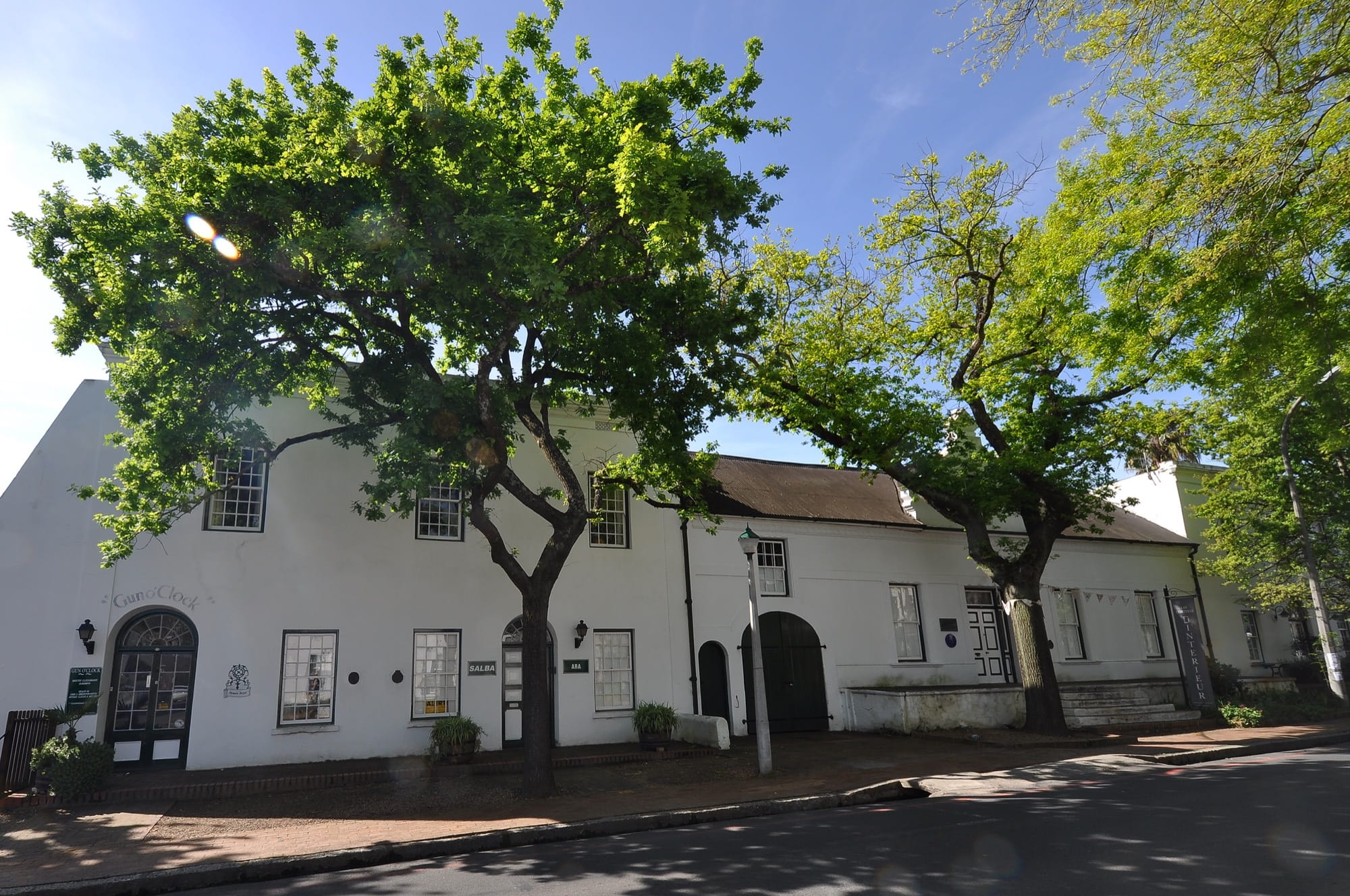
The two towns in one paragraph each
Stellenbosch is a university town, the second-oldest in South Africa, with a walkable historic core of oak-lined streets (Dorp Street is the classic), Cape Dutch houses, a market, museums, student cafés and enough restaurants that you never eat in the same place twice. It gave the country its first wine route, established in 1971, and the estates radiate out from town in every direction: Helderberg to the south, Simonsberg to the north, the Jonkershoek valley to the east. That spread is the point and the problem. There is more to choose from, and it is harder to do without a car.
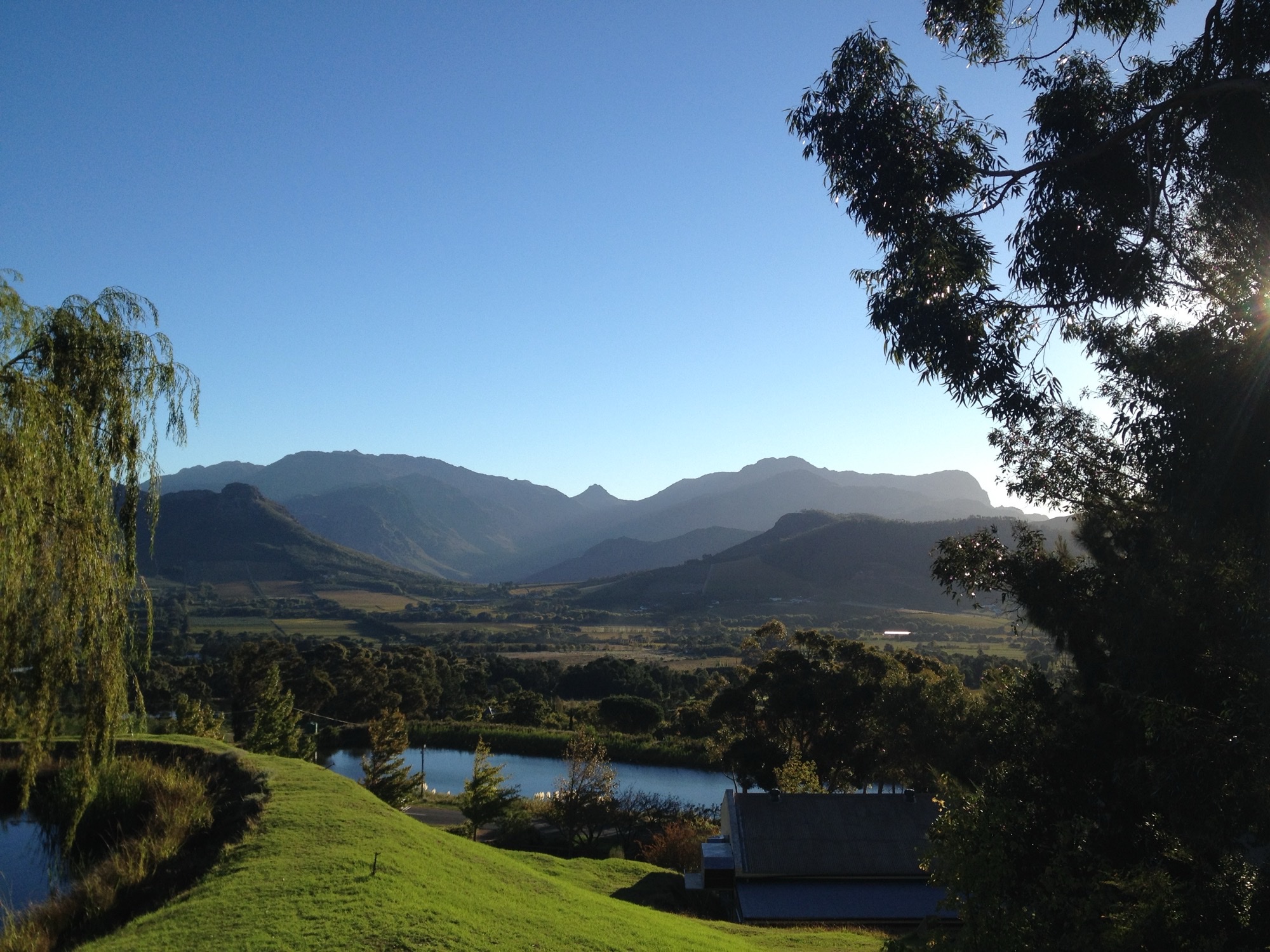
Franschhoek is a village at the closed end of a valley, settled by French Huguenots in the 1680s and now organised around one main road with the Huguenot Memorial at the top, a museum, galleries, and a density of well-known restaurants that is out of proportion to its size. The estates line the valley floor and its lower slopes, close enough together that the Franschhoek Wine Tram can string them on five colour-coded hop-on hop-off lines from a terminal on the main road. It is smaller, prettier, quieter at night and more expensive.
Decision 1: how many Winelands nights you have
| Nights | Choose | Why |
|---|---|---|
| 0 (day trip from Cape Town) | Either, as a day trip; Stellenbosch is closer | Stellenbosch is 54 km / about 45 minutes from the city, Franschhoek 75 km / just under an hour. A guided day tour usually covers both; a self-drive day does one properly |
| 1 | Stellenbosch | Less driving on the transfer days (34 km from the airport, 54 km from the city) and a town to walk in the evening; Franschhoek's tram needs a full day you do not have |
| 2 to 4 (the 10-day plan) | Franschhoek, unless you are driving and prefer a town | One tram day on foot, one Stellenbosch estate day with the Vine Hopper or a designated driver, and an optional day to Hermanus or Paarl; the village is walkable every evening |
| 5 or more | Stellenbosch | More estates within 20 minutes, more restaurants and shops, lower nightly rates, and Franschhoek is a comfortable day trip for the tram |
Decision 2: car, or no car
This is the decision that most often settles it. Franschhoek works without a car in a way Stellenbosch does not. The Wine Tram's hop-on hop-off ticket (R350 per adult, R90 for children aged 3 to 17) departs from the Franschhoek Terminal on the corner of Main Road and Cabriere Street between 08:45 and 13:00, and its Navy and Orange lines can also be joined at the Groot Drakenstein Terminal on the R45. Tastings are extra (R60 to R260 per estate) and estate lunches should be booked at least 24 hours ahead, but the whole day, from the first departure to dinner, can happen on foot from a village bed. The operator will even add a transfer from Cape Town if you book it at least 48 hours ahead.
Stellenbosch's answer is the Vine Hopper, the hop-on hop-off bus run by the Adventureshop since 2003: R450 per person, three routes that each visit five or six estates, tastings extra at roughly R55 to R120 per farm, with a two-day pass available. The catch is that each route runs on set days (Northern route Monday, Wednesday and Friday; Southern Tuesday, Thursday, Saturday and Sunday; Eastern on weekdays), so a two-night stay may only give you one of them. Uber lists Stellenbosch as a service area and e-hailing is fine for town-to-estate hops on the near side, but a return from a farm 15 km out at 16:00 can be a long wait. With a car and a designated driver, Stellenbosch is the better base; with neither, Franschhoek is.
Decision 3: what you want the days to feel like
- Food first: Franschhoek. The restaurant density per street is the highest in the Winelands and most of the estate restaurants are on the tram lines. Book them.
- Wine first, with range: Stellenbosch. More producers, more styles, and the Helderberg and Simonsberg slopes within 20 minutes in opposite directions.
- Evenings that need no plan: Stellenbosch. Franschhoek's main road is charming and short; by the third night you know it.
- Quiet and views from the room: Franschhoek, with the mountains closing the valley on three sides.
- Families: either works; Stellenbosch has more room to move and easier parking, Franschhoek has the tram, which children treat as the attraction.
- Budget: Stellenbosch is usually cheaper for the same standard of room, and a bigger town means more mid-range choice.
- History and streetscape: Stellenbosch's oak-lined core wins on foot; Franschhoek's Huguenot story is a museum and a monument rather than a quarter.
What the choice does to the 10-day route
The pillar route gives the Winelands four nights (days 6 to 9) after five in Cape Town. With Franschhoek as the base, Day 6 drives out through Stellenbosch (a walk and one estate on the way) and over the Helshoogte Pass; Day 7 is the tram on foot; Day 8 returns to Stellenbosch for the Vine Hopper or self-drives the Boschendal and Babylonstoren side of the valley; Day 9 is an optional Hermanus day over the Franschhoek Pass (93 km each way); Day 10 is a 71 km run to the airport. Nobody drives after a tasting on days 7 and 8, and the evenings are on foot.
With Stellenbosch as the base, the same nights work in reverse: Day 6 drives straight to town (54 km) with an afternoon on Dorp Street and a nearby estate; Day 7 is the Vine Hopper (check the weekday) or a self-drive day; Day 8 is Franschhoek for the tram, 31 km each way with the car parked at the terminal, which means a designated driver or a very early last tram; Day 9 Hermanus is 94 km each way, much the same; Day 10 is 34 km to the airport. You gain walkable evenings in a real town and lose the car-free tram day. If you would rather not choose, the compromise is real: two nights in each, at the cost of one more pack-and-move in a trip that already has one.
Getting there and between them
From Cape Town, Stellenbosch is 54 km by the N1 and R304 or the N2 and R310, about 45 minutes without traffic; Franschhoek is 75 km and a little under an hour by either route, or via Stellenbosch and the Helshoogte Pass, which is the scenic way and costs ten minutes. From the airport, Stellenbosch is 34 km and about 35 minutes, Franschhoek 71 km and just under an hour, so a Winelands-first trip suits an early arrival. Between the two towns the R310 over Helshoogte is 31 km and about 30 minutes, past Boschendal at the bottom of the pass. There is no useful scheduled public transport for any of these legs; the choice is a hire car, a private transfer or, for the tram day only, the Wine Tram's own Cape Town transfer. The driving realities (left-hand traffic, licence rules, the airport road advice) are in Getting Around Cape Town and the Winelands.
Season notes for November to March
Both towns are hotter than the coast in summer, often by several degrees in the afternoon, and mostly out of the south-easter that shapes Cape Town beach days, which is why a windy city day is a good Winelands day (see Cape Town in January). Estates and restaurants are busiest from about 16 December to 12 January, when South African schools are on holiday; book tastings with lunch, and book the tram line and time rather than turning up. Harvest starts in late summer, so February and March visits often see picking in the vineyards. The Franschhoek Wine Tram noted in September 2026 that Noble Hill had been added to its Orange line and that Mont Rochelle's tasting had temporarily moved to another venue during building work; details like this change, so check the current line map when you book.
Stellenbosch or Franschhoek FAQ
Is Stellenbosch or Franschhoek better for a first visit?
Can you do the Winelands without a car?
How far apart are Stellenbosch and Franschhoek?
Which is cheaper, Stellenbosch or Franschhoek?
Should I split my nights between the two?
Is one better for families?
Photo credits
Hero: Franschhoek vineyard with the valley mountains, by South African Tourism, CC BY 2.0, via Wikimedia Commons. Dorp Street oaks by Steven Morrow, CC BY-SA 3.0, via Wikimedia Commons. Franschhoek valley by Bernard303, CC BY-SA 4.0, via Wikimedia Commons. All resized.