


On this route
Stay in the south if you have fewer than five nights, if you are not renting a car, or if the point of the trip is warmth and a beach outside the door. Stay in the north if you have a car, a week, and you came for Anaga's laurel forest, the old towns and the drive up to Teide, and you can live with cloudier mornings. Do both, three nights north and four south, if you have seven nights and a car: that is the split the seven-day itinerary is built on, and the rest of this article explains why the numbers point that way rather than to "it depends".
What "north" and "south" mean here
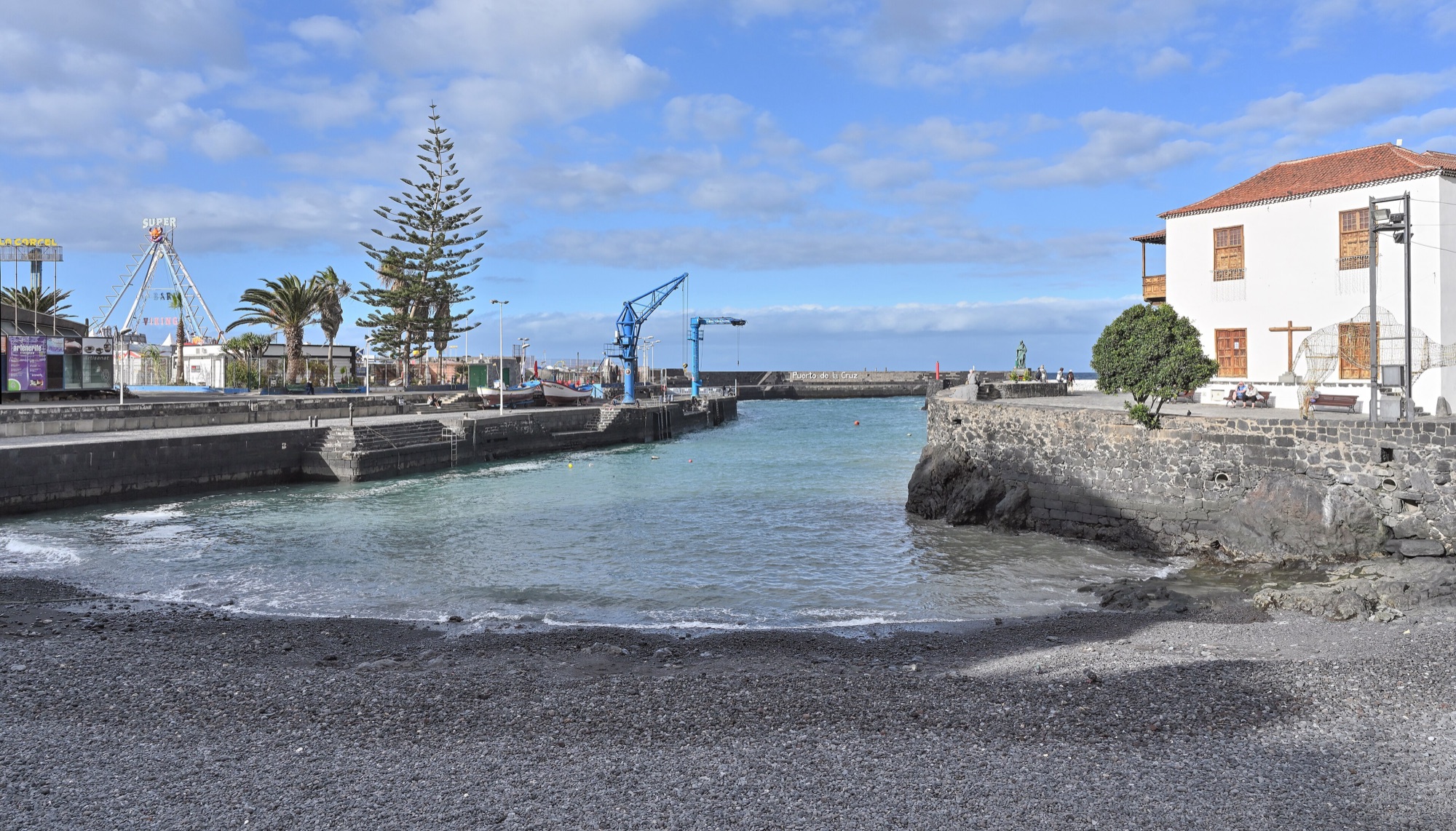
North means the Orotava valley coast: Puerto de la Cruz, the old resort town with black-sand beaches and sea pools, and La Orotava, the historic town ten minutes uphill. It also reaches west to Icod and Garachico and east, via the motorway, to La Laguna and the Anaga massif. South means the Costa Adeje, Playa de las Américas and Los Cristianos strip: purpose-built resorts, golden sand, the south's bus interchange and the island's main airport 30 minutes away. Santa Cruz, the capital on the east coast, is a third option for people who want a city, and it is mentioned where it matters.
The comparison in one table
| Criterion | North: Puerto de la Cruz | South: Costa Adeje / Los Cristianos |
|---|---|---|
| January weather (AEMET normals) | No coastal station. Nearest: Tenerife North airport at 632 m, 16.0 °C by day, 80 mm; the coast below is warmer than that and cloudier than the south | Tenerife South airport, 64 m: 21.7 °C by day, 15.2 °C at night, 17 mm, fewer than 2 rain days, 193 sunshine hours |
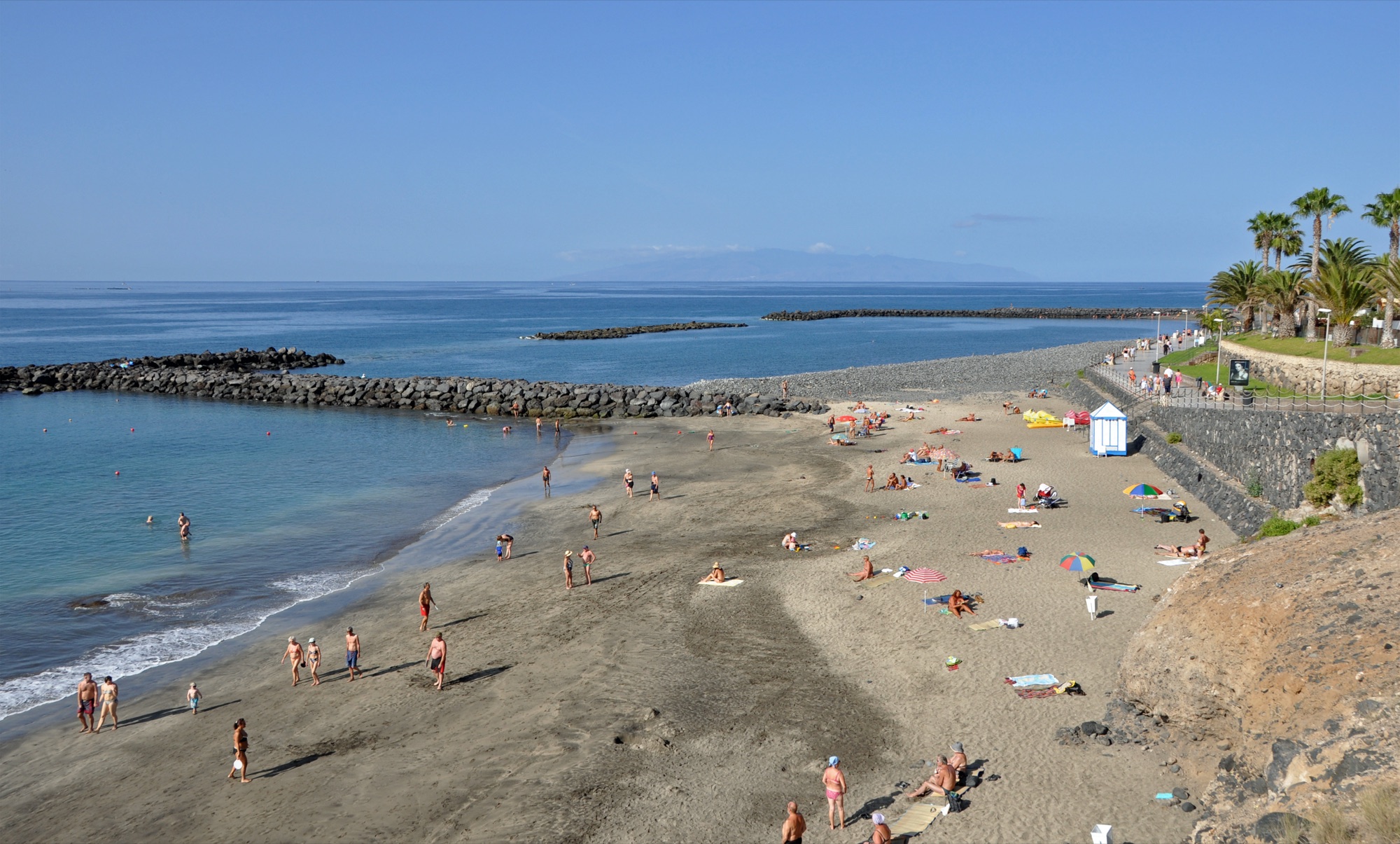
| Beaches | Black volcanic sand (Playa Jardín, Martiánez), sea pools; winter surf | Sheltered golden-sand beaches with breakwaters (Duque, Fañabé, Las Vistas) |
| Towns | Puerto's old harbour quarter, La Orotava, Garachico, Icod; La Laguna's UNESCO centre 30 min | Resort architecture; Adeje old town inland; Santa Cruz 55 min by motorway |
| Drive to the Teide cable car | 41 km on the TF-21, plan 1 h 15 | 52 km via Vilaflor on the TF-21, plan 1 h 15 |
| Drive to Anaga (Cruz del Carmen) | 37 km, plan 1 h | 94 km, plan 1 h 45 |
| Drive to Masca | 45 km, plan 1 h 15 | 33 km, plan 55 min |
| Airport | TFN 31 km / 26 min; TFS 98 km / 1 h 30 or more | TFS 21 km / 30 min; TFN 85 km / 1 h |
| Bus hub (car-free) | Lines to Santa Cruz every 30 min; Teide bus 348 once a day; 343 to the airports and the south five or six times a day | Estación Costa Adeje: line 111 to Santa Cruz every 30 min daily; Teide bus 342 once a day; 473/477 to Los Gigantes every 30 to 40 min; 40 to the airport every 30 min |
| Best for | Hikers, old towns, people who dislike resorts, second visits | Beach, families, short trips, car-free trips, warmth |
The weather row is where most comparisons go wrong. The 80 mm and 16 °C usually quoted for "the north" belong to an airport 632 m up on the La Laguna plateau, in the trade-wind cloud. Puerto de la Cruz is at sea level on the same side of the island. AEMET publishes no normals for it, so the honest description is warmer than the plateau, cloudier than the south, with showers rather than wet days. The January weather article lays out all four stations and the rest of the winter months.
Decide by trip length
Three or four nights. One base, and in winter that base is the south. Teide is a day trip up the TF-21 from Vilaflor, Masca and Los Gigantes are a half-day, and the beach fills the rest. A second base on a four-night trip costs you a packing morning and a driving afternoon for one night's benefit.
Five or six nights. Still one base for most people, and now the choice is real. South if the beach matters; north if you want Anaga and the towns and will do Teide from the north and the south coast as a single day. Two bases only if you would rather spend an afternoon moving than an hour and a half each way for Anaga.
Seven nights. Two bases, north first if you fly into Tenerife South. The extra hotel change buys you Anaga and Garachico from a base an hour away instead of nearly two, and it lets the Teide visit ride on the transfer day instead of taking its own. This is the itinerary's split: Puerto de la Cruz nights 1 to 3, over the mountain, Costa Adeje or Los Cristianos nights 4 to 7.
Ten nights or more. Two bases plus either a night at the Parador inside the park or a couple of nights on La Gomera, which stops being a day trip and becomes an island.
Decide by transport
With a car the island is under two hours across and every comparison above holds. Without one the south wins on the numbers, and not narrowly. Estación Costa Adeje is the south's interchange and the best-connected place to stay without a car: line 111 to Santa Cruz via the airport every 30 minutes on a January weekday and on a January Sunday alike, line 473 or 477 to Los Gigantes every 30 to 40 minutes, line 40 to the airport every half hour, and the one-a-day Teide bus 342 (out at 09:15, back from El Portillo at 15:15, with about four and a half hours at the cable car). Puerto de la Cruz has its own frequent lines to Santa Cruz and La Laguna and its own one-a-day Teide bus 348 (09:30 out, 16:00 back), but its links to the south are the five or six daily 343 buses via both airports, and Anaga by bus from either base is a long day of connections. The car-free article works through each day of the week plan from a south base; the short version is that Teide, Santa Cruz, La Laguna, Los Gigantes and the whales all work from the south by bus, and Anaga and Garachico are the ones that do not fit well.
Decide by what you came for
Hikers: north, and it is not close. Anaga's ridge and coast trails start an hour away, the Teide trails are an hour and a quarter, and Garachico and the Teno coast are on the way to Masca. Beach and pool: south. Families with young children: south, for the sheltered beaches and the short airport run, with Teide and Los Gigantes as the outings. Culture and food without a resort: Santa Cruz or La Laguna, honestly, more than either resort coast; Puerto de la Cruz is the compromise if you also want the sea. Couples on a first visit who want a bit of everything: both, in the 3 + 4 split.
What each choice does to your nights and your driving
Take the same seven nights and the same sights (Anaga, the north towns, Teide, Masca and Los Gigantes, a beach day, the airport runs; the flexible last day left out) and count the driving with the itinerary's planning times.
| Plan | Nights | Hotel changes | Driving over the week | What you lose |
|---|---|---|---|---|
| Both, north first (the itinerary) | Puerto de la Cruz 3, Costa Adeje 4 | 1, on the Teide day | About 13 hours | One packing morning |
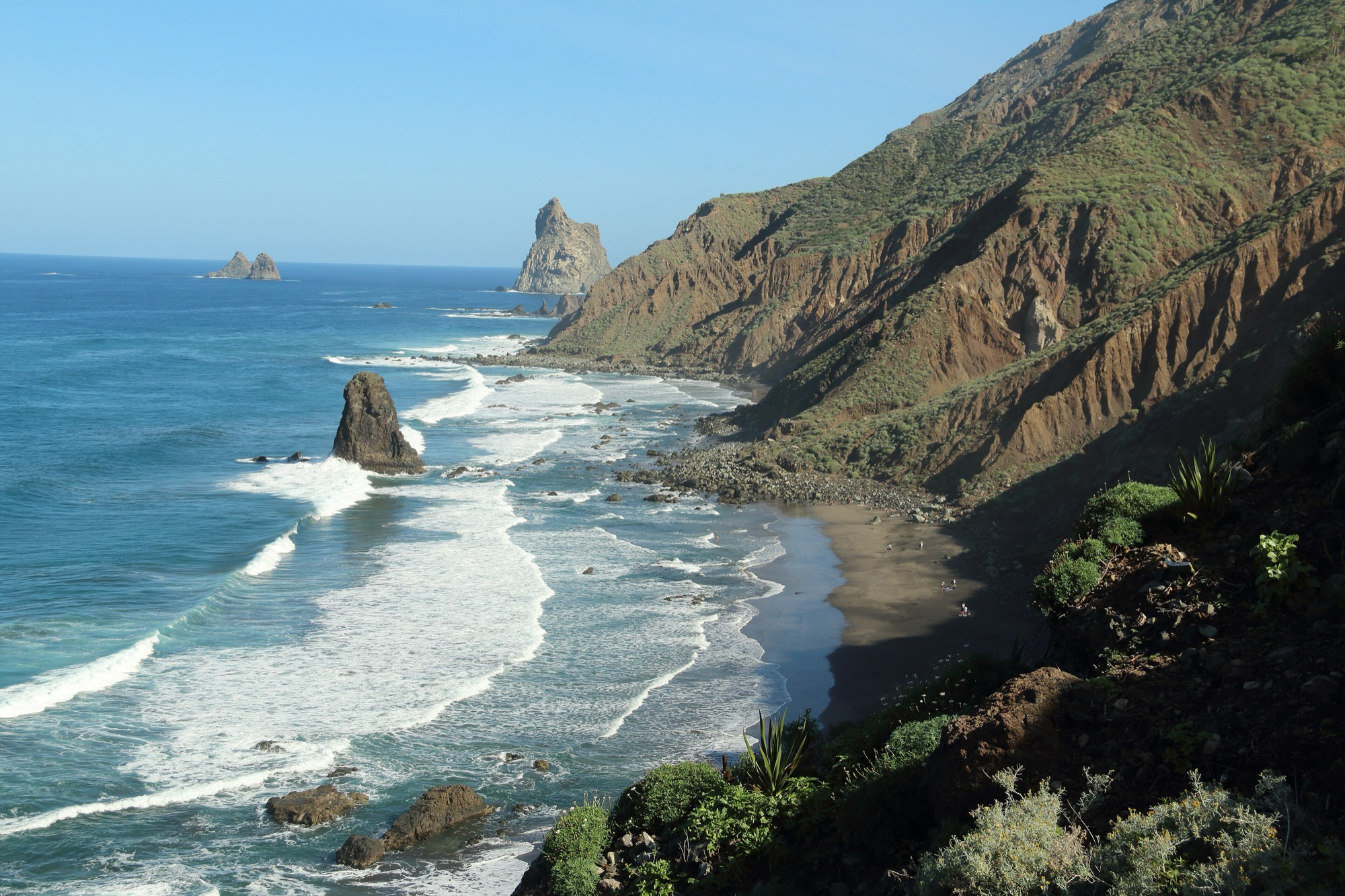
| South only | Costa Adeje 7 | 0 | About 15 hours | Benijo (Anaga becomes a 3 h 30 round trip, turn back at Taganana); the north towns become one long day |
| North only | Puerto de la Cruz 7 | 0 | About 16 hours, including a 1 h 45 airport drive on the last morning | Warm evenings; Masca and Los Gigantes become one long day; the south beaches become a day trip |
The two-base plan is the least driving because Teide is on the transfer and both Anaga and Masca are done from the near base. The south-only plan is the least hassle, and its cost is a specific one: the far end of Anaga. The north-only plan is the best week for a hiker and the worst for a morning flight home.
The airport rule
Almost all northern European leisure flights and Air Canada's new non-stops use Tenerife South, which carried 14 million passengers in 2025 against Tenerife North's 7.2 million, most of the latter domestic and inter-island. Flights home tend to leave in the morning: Air Canada's January 2027 departures are 11:20 to Toronto and 11:15 to Montreal. That puts the last night in the south for anyone flying from TFS, and reverses the order for anyone flying from TFN. Whatever the comparison above says about your tastes, the last night goes where the airport is.
Questions people ask about north versus south Tenerife
Is north Tenerife better than the south?
Is it worth staying in both north and south Tenerife?
Is the north of Tenerife cold in winter?
Which side is better without a car?
Where should I stay in Tenerife for Teide?
Should my last night be in the north or the south?
How this was checked
Climate figures are AEMET's 1981-2010 normals for Tenerife South airport, Santa Cruz and Tenerife North airport; AEMET publishes no normals for the north coast itself. Driving distances and engine times are OpenStreetMap routing estimates without traffic; the planning times add our allowance for the mountain roads. Bus frequencies are from TITSA's published timetable feed for 20 and 24 January 2027 where loaded, and for 16 and 20 December 2026 for the Los Gigantes and airport lines; recheck on titsa.com before travel. Airport figures are Aena's 2025 data and flight times are Air Canada's January 2027 timetable. Nothing here is a first-hand account.
Photo credits
- Cover: Acantilados de Los Gigantes, Tuxyso, CC BY-SA 4.0, via Wikimedia Commons, resized.
- Harbour of Puerto de la Cruz, Cayambe, CC BY-SA 4.0, via Wikimedia Commons, resized.
- Playa del Duque, Costa Adeje, Marc Ryckaert (MJJR), CC BY 3.0, via Wikimedia Commons, resized.
- Playa de Benijo, FrDr, CC BY-SA 4.0, via Wikimedia Commons, resized.