


On this route
Seven nights on Tenerife is enough for both coasts and the volcano if you stop treating the island as small. It is more than 2,000 m of altitude between the beach and the cable car station, and the roads that make the island interesting (the TF-21 over Teide, the TF-12 into Anaga, the TF-436 to Masca) are slow. This plan gives the north coast three nights and the south four, crosses Teide National Park on the one day you change hotel, and keeps two half-days empty for weather. It is built for people landing at Tenerife South, which is where almost every UK, German and Canadian flight arrives, and it ends thirty minutes from that airport because most flights home leave in the morning. If you are still deciding whether to bother with two bases at all, the north or south comparison settles that first.
The route at a glance
- Duration
- 7 days / 7 nights
- Bases
- 2 (Puerto de la Cruz, Costa Adeje or Los Cristianos)
- Transport
- Rental car from Tenerife South; TF-5 and TF-1 motorways between coasts, TF-21 across Teide National Park, TF-12 in Anaga, TF-436 to Masca; TITSA buses as the fallback on every leg
- Pace
- Balanced: one base change, two buffer half-days, one flexible last day
- Best season
- October to March; checked against 2026 cable car hours, January 2027 bus timetables and AEMET 1981–2010 climate normals
Nights by base
- Puerto de la Cruz 3 nights
- Costa Adeje or Los Cristianos 4 nights
The order is not a matter of taste. You land in the south, drive an hour and a half to the north coast while you are fresh, spend three days on the green side of the island, then climb the TF-21 through the national park and come down the far side to the south. The Teide visit costs you no extra driving day because it sits on the transfer. The last four nights are in the south so that the drive to the airport on the morning you leave is half an hour, not ninety minutes over a mountain.
Which airport, and why it decides the order
Tenerife has two airports and they serve different markets. Tenerife South (TFS) handled 14 million passengers in 2025, 12.8 million of them international, with the United Kingdom and Germany making up more than half of the traffic. Tenerife North (TFN), 20 km from Puerto de la Cruz, handled 7.2 million, mostly domestic and inter-island flights, with Madrid as its biggest route. If you are flying from Britain, Ireland, Germany, the Netherlands, Scandinavia or Canada, assume TFS unless your ticket says otherwise. Air Canada's new non-stop A321XLR flights also use TFS: in the January 2027 timetable the Toronto flight lands at 10:05 and the return leaves at 11:20, and the Montreal flight lands at 08:20 with the return at 11:15.
A morning departure from TFS is the reason the south comes last. From Costa Adeje the airport is 21 km and about 30 minutes. From Puerto de la Cruz it is 98 km and, allowing for the airport return of the car, close to two hours at the time of day when you least want to find out about roadworks on the TF-5. If your flights use TFN instead, reverse the bases: south first, north last, with a 30-minute drive to the airport at the end. Nothing else in the plan changes.
Who this plan suits
It suits a first visit with a rental car, couples or families who want the laurel forest, the old towns and the volcano as well as a beach, and anyone who has read that Tenerife is "just resorts" and doubts it. It works from October to March because the south coast stays warm (Tenerife South airport's January normals are 21.7 °C by day, 15.2 °C at night, 17 mm of rain in the month and 193 hours of sunshine) and because the north coast, while cooler and cloudier, is not the washout that the La Laguna airport figures suggest. That station sits at 632 m on a plateau, and its 80 mm and 13.1 °C mean for January describe the plateau, not the seafront at Puerto de la Cruz. The January weather article lays the four stations side by side.
It does not suit people who want to sit on one beach for a week (stay south and skip the base change), anyone who cannot drive mountain roads, or a trip of fewer than five nights, where the second base costs more than it gives. If you are not renting a car, the bus version explains which of these seven days survive and which do not.
The seven days
Day 1: land at Tenerife South, drive to the north coast
Collect the car and take the TF-1 east and then the TF-5 west through Santa Cruz to Puerto de la Cruz: 98 km and 81 minutes by the routing engine, so allow an hour and a half to an hour and three quarters with the pickup queue. From a 10:05 landing you are checking in by early afternoon. Sunset in mid-January is 18:30, so even a late-afternoon arrival leaves time for the harbour, the Plaza del Charco and the old streets around the Casa de la Aduana. If you are in Puerto before 14:00, La Orotava is ten minutes uphill and its centre is best in the afternoon light. That is the whole programme for the day. If your flight lands after 18:00, Day 1 is only the drive, and nothing later in the week depends on it.
Day 2: Anaga, from the laurel forest to Benijo
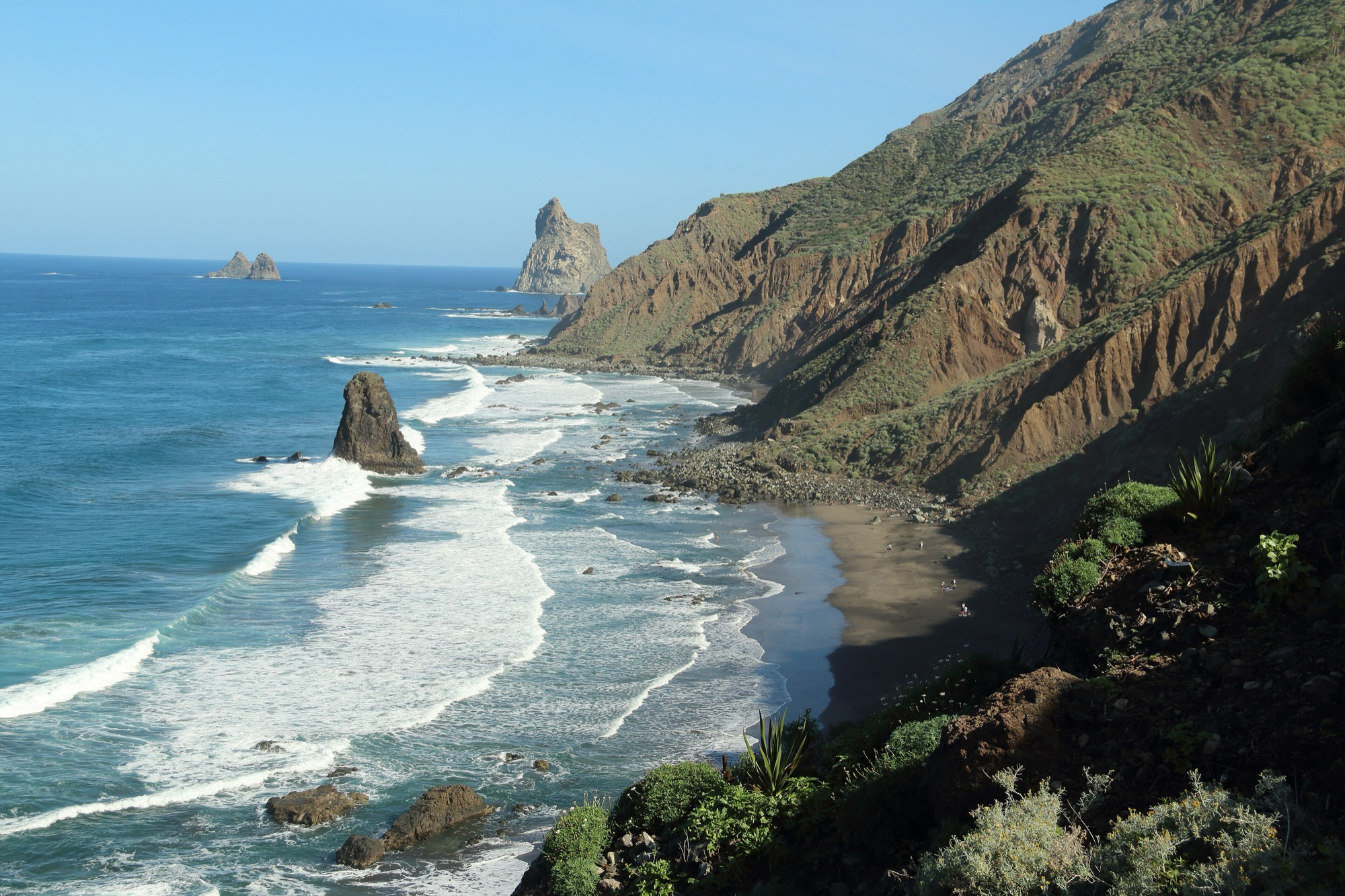
Leave by 09:00 and take the TF-5 to La Laguna, then the TF-12 up to Cruz del Carmen. It is 37 km and the engine says 37 minutes, but the last third is a ridge road with buses on it, so plan for an hour. Cruz del Carmen has the Anaga visitor centre and the short, easy Sendero de los Sentidos loop through the laurel forest. The ridge is often in cloud in the morning. Do not wait for it to lift; carry on along the TF-12 and down the TF-134 to Taganana and on to Benijo, on the north side, which is usually clearer by midday. Lunch at Benijo or Almáciga, then walk the black-sand beach below the Roques de Anaga. The return by San Andrés, Santa Cruz and the TF-5 is 64 km and about an hour and a quarter, which leaves time for a stop in La Laguna's old centre, a UNESCO site, on the way back. Total driving is about 125 km and three and a half hours. None of these trails need a permit; the two Anaga trails that do (El Pijaral and the Cruz de Afur path) are not on this route.
Day 3: La Orotava, Icod and Garachico
This is the north's buffer day and the shortest drive of the week: La Orotava (7 km), then the TF-5 west to Icod de los Vinos for the Drago Milenario (23 km), the TF-42 down to Garachico (6 km) for the El Caletón lava pools and the plaza, and back. About 70 km and under two hours of driving in total, with the afternoon spare. If Day 2 was rained off, do Anaga today and let Garachico go. If it is raining on the whole north coast, Loro Parque in Puerto de la Cruz is the indoor-ish alternative, and this is the day for it.
Day 4: over Teide to the south (the base change)
Book the cable car for about 10:30 to 11:00 before you travel, and leave Puerto de la Cruz at 08:00 with the bags in the boot. The TF-21 climbs through La Orotava and the pine belt to El Portillo at the edge of the caldera: 41 km to the cable car station, 51 minutes by the engine, an hour and a quarter in practice. The cable car lifts you from the base station to La Rambleta at 3,555 m in a few minutes. The summit is 3,718 m and the last 163 m on foot, the Telesforo Bravo trail, needs a permit (see the booking section). Without one you still get the viewpoint path from the top station to the Fortaleza viewpoint (PNT-11, 0.6 km, free access, no reservation) and the sea of cloud over the north. Izaña, the weather station on the caldera rim at 2,369 m, has a January mean minimum of 1.1 °C and 12 frost days in the month, so bring a warm layer and a windproof even on a sunny day.
Back at the car, drive ten minutes to the Parador car park for the Roques de García loop, the classic walk under the Roque Cinchado with Teide behind it. Then continue south on the TF-21 through Vilaflor to Costa Adeje: 52 km, 53 minutes by the engine, an hour and twenty minutes with the hairpins. You are in the south by about 17:00 with the whole national park behind you and no separate Teide day to find. Total driving: about 92 km.

Day 5: beach, or nothing
A rest day by design, and the day that absorbs a closed Teide road. Playa del Duque and Fañabé are on the doorstep in Costa Adeje; El Médano, 25 km east, has a long natural beach and a windier, less manicured feel. Siam Park is the family option. If you would rather see a second island, this is the only day a La Gomera trip fits: the Fred. Olsen fast ferry from Los Cristianos takes 50 minutes each way, and the day works only on the first sailing out and the last back. We would not add it to a seven-night plan that already has Teide, Anaga and Masca in it, but it is your buffer day to spend.
Day 6: Masca viewpoints, Los Gigantes and the whales
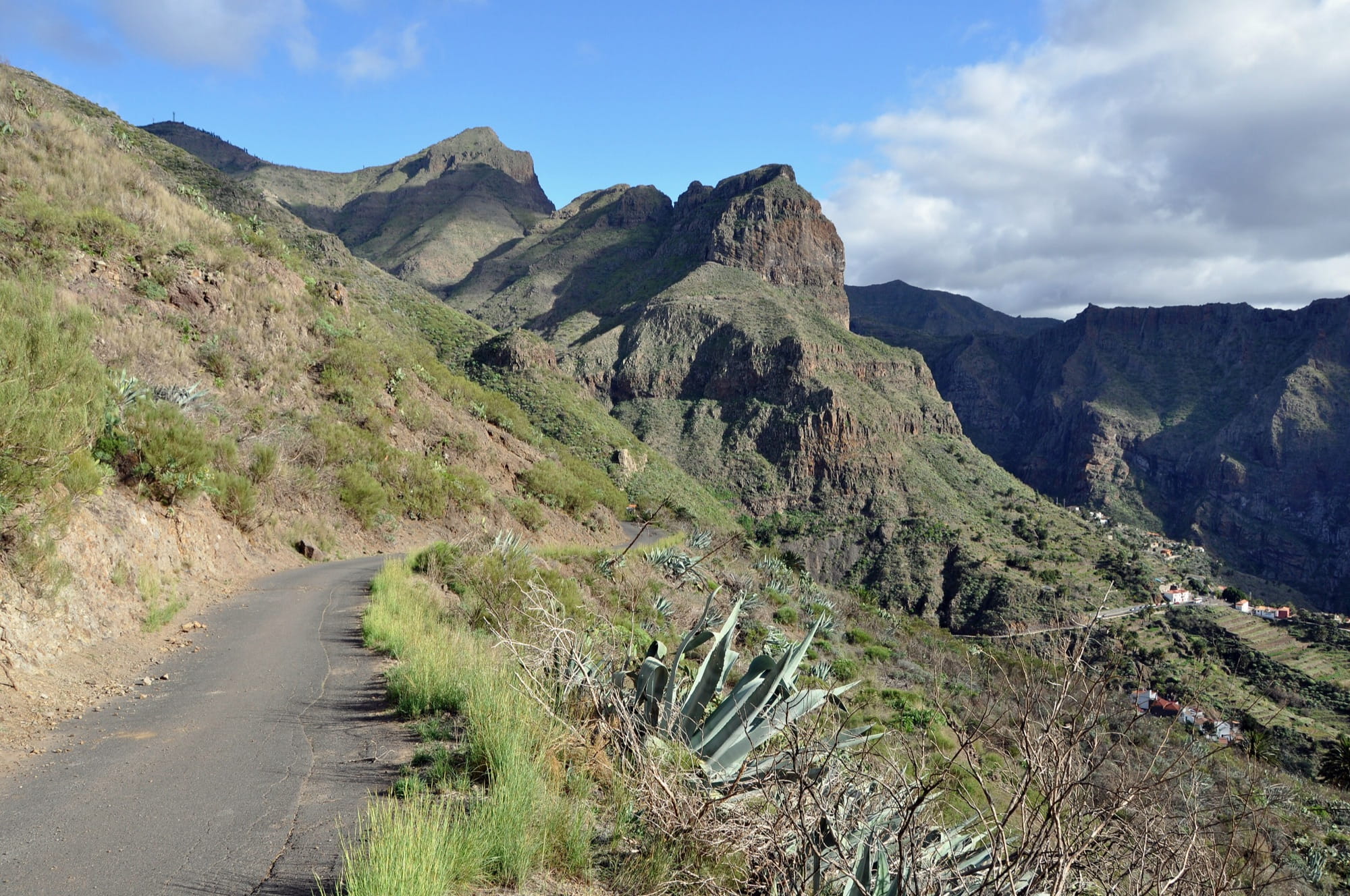
Take the TF-1 and TF-82 through Guía de Isora to Santiago del Teide, then the TF-436 up over the pass and down to Masca. The engine gives 33 km and 29 minutes from Costa Adeje; plan on 55 minutes, because the TF-436 is narrow, winding and busy. Go early: congestion on this one road into the hamlet is the reason the Cabildo restricted it in summer 2026. Walk to the viewpoints over the gorge and the hamlet, and then go back the way you came. This plan does not include the gorge walk itself: that is a booked, four-hour descent to a jetty with a boat out, and it replaces this whole day if you choose it (see what this plan leaves out).
From Santiago del Teide the TF-454 drops to Los Gigantes in about 20 minutes. The cliffs are best from the sea, which is the argument for a whale and dolphin trip in the early afternoon: pilot whales are resident off this coast and seen almost all year, boats leave from Los Gigantes, Puerto Colón and Los Cristianos, and the ones to book carry the Blue Boat flag, the certification of a licensed operator. Two-hour trips are the standard format. Back to Costa Adeje along the coast (25 km). Total driving about 90 km.
Day 7: a flexible last day
Three honest options, and the choice depends on what the week did to you. A: Teide at sunset from the south. The TF-21 via Vilaflor is 52 km and about an hour and a quarter to the cable car car park; watch the light go from the Llano de Ucanca, then drive down in the dark (slowly, with the park roads empty). B: the east side you have not seen: Candelaria's basilica and Santa Cruz, an hour along the TF-1. C: the beach and an early night. Whatever you choose, be back at the base for the evening: the airport is 30 minutes away and the morning flights (Air Canada's 11:15 and 11:20 departures, and most European ones) want you there by about 09:00.
Teide bookings and the closure rule
Three separate things need attention, and they are run by different bodies.
| Period | Hours | Last ascent | Last descent |
|---|---|---|---|
| 1 January to 27 March 2026 | 09:00 to 17:00 | 16:00 | 16:50 |
| 25 October to 31 December 2026 | 09:00 to 17:00 | 16:00 | 16:50 |
| Return ticket, non-resident adult / child 3 to 13 | EUR 42.00 / EUR 21.00 (one way is half); base car park 08:00 to 18:00 | ||
The 2027 table was not yet published when this was checked in September 2026; the winter pattern has been the same both halves of 2026. Book online for a time slot, which the operator recommends to avoid the midday queue at the base station, and check its status page on the morning: the lift can be suspended for weather, and that is the operator's call.
The summit permit is a different system. Places for the Telesforo Bravo trail are released on Tenerife ON every Monday at 07:00 Canary time for the following 56 days, in two-hour slots between 09:00 and 17:00 that match the cable car hours (plus early and late slots outside them). Since 19 January 2026 the daytime slots carry a fee: free for Tenerife residents and under-14s, EUR 6 for other Canary residents, EUR 15 for everyone else, non-refundable unless the trail is closed. One booking per person every 15 days, ID or passport on the day, and the slot fixes both your entry and your exit, so a delayed cable car does not extend it. The Montaña Blanca trail (PNT-07), the on-foot approach from the road, has its own permit and fee.
The third thing is the road, which the Cabildo closes when there is snow or ice, as described in the Day 4 note. It has happened several times in recent winters, reopening follows the road crews' inspection, and the buffer on Day 5 exists for exactly this.
Driving times you should actually plan with
The routing-engine figures below are OpenStreetMap estimates without traffic. Motorway legs are close to right. The mountain legs are not, so the last column is what we planned the days with.
| Leg | Road | Distance | Engine | Plan with |
|---|---|---|---|---|
| TFS to Puerto de la Cruz | TF-1, TF-5 | 98 km | 1 h 21 | 1 h 30 to 1 h 45 |
| Puerto de la Cruz to Cruz del Carmen | TF-5, TF-12 | 37 km | 37 min | 1 h |
| Cruz del Carmen to Benijo | TF-12, TF-134 | 23 km | 26 min | 45 min |
| Benijo to Puerto de la Cruz | TF-11, TF-5 | 64 km | 1 h 03 | 1 h 15 |
| Puerto de la Cruz to Garachico via Icod | TF-5, TF-42 | 29 km | 37 min | 45 min |
| Puerto de la Cruz to the Teide cable car | TF-21 | 41 km | 51 min | 1 h 15 |
| Teide cable car to Costa Adeje via Vilaflor | TF-21 | 52 km | 53 min | 1 h 20 |
| Costa Adeje to Masca | TF-1, TF-82, TF-436 | 33 km | 29 min | 55 min |
| Santiago del Teide to Los Gigantes | TF-454 | 15 km | 17 min | 20 min |
| Los Gigantes to Costa Adeje | TF-47, TF-1 | 25 km | 26 min | 30 min |
| Costa Adeje to TFS | TF-1 | 21 km | 30 min | 30 min |
| Puerto de la Cruz to Costa Adeje by motorway (closure fallback) | TF-5, TF-1 | 67 km | 1 h 09 | 1 h 15 |
What this plan leaves out
The Masca gorge walk. It is the island's most famous hike and the one with the most rescues in the Canaries, and it is regulated: a booked descent slot on the official site (general price from EUR 40.66, free for Tenerife residents, no under-8s, trail open 08:30 to 18:00), arrival by TITSA bus 355 from Santiago del Teide at least an hour before your slot, a helmet loan and a boat out from the jetty to Los Gigantes booked separately, or the climb back up. Budget the whole of Day 6 for it and keep the viewpoints for the drive in.
La Gomera. A real island, not a day trip. The 50-minute ferry makes a long day from Los Cristianos possible, but it only fits by spending Day 5, and then you have no buffer for a closed Teide road.
A third base. Some plans add a night at the Parador inside the park for the stars. It is a good night, but on seven nights it forces either a second hotel change in three days or a shorter south stay, and the sunset drive on Day 7 gets most of the sky for none of the packing.
If you are not driving
The skeleton of this week survives by bus, but not all of it. Bus 343 links Puerto de la Cruz with both airports and Costa Adeje five or six times a day, bus 348 runs one bus a day from Puerto de la Cruz to the cable car (09:30 out, 16:00 back, giving you the middle of the day up there) and 342 does the same from Costa Adeje. Anaga and the Garachico loop are the parts that get awkward, and Masca depends on bus 355 anyway. The car-free version of this week goes through each day with the January weekday and Sunday timetables.
Three variants
Entry, driving and money
Tenerife is Spain and the Schengen area. EU citizens need only a passport or national ID card. British, Canadian and other visa-exempt visitors get 90 days in any 180 and are now registered in the EU's Entry/Exit System with fingerprints and a photo instead of a stamp. ETIAS, the EUR 20 pre-travel authorisation, was not yet in operation when this was checked in September 2026; the EU says it will announce the start date several months ahead, so check the official site before a winter 2026-27 trip. Your passport should be valid for three months beyond the day you leave.
The rental car matters more than the hotel. Book a small car with the airport desk of a local firm rather than the cheapest broker, take the full insurance if the excess makes you nervous on the TF-436, and pick it up with a full tank. Card payment is universal in the resorts and the towns; carry some cash for Anaga and Masca cafés. Prices for the cable car and the permit are above; everything else on this route is free or a lunch.
Questions people ask about a week on Tenerife
Is one week enough for Tenerife?
Should I stay in the north or the south first?
Do I need a permit for Teide?
Can I drive to Masca?
How cold is Teide in winter?
Is the north of Tenerife rainy in winter?
How this plan was checked
Cable car hours and prices are the operator's 2026 tables read on 19 September 2026. Permit rules and fees are from Tenerife ON and the Cabildo's January 2026 notice. Masca rules are from the official booking site and the Cabildo's summer 2026 access notices. Bus frequencies are from TITSA's published timetable feed for 20 and 24 January 2027 where the January calendar was loaded, and for 16 and 20 December 2026 where it was not (bus 355 and the Los Gigantes lines); recheck on titsa.com before travel. Flight times are Air Canada's timetable for 14, 16, 22 and 24 January 2027. Distances and engine times are routing estimates on OpenStreetMap data without traffic; the planning times are our allowance for the mountain roads, not a measurement. Climate figures are AEMET 1981-2010 normals. Sunset is calculated for the date. Entry rules are from the EU's official ETIAS and EES pages. Nothing here is a first-hand account.
Photo credits
- Cover: Teide and the Roques de García in January, Diego Delso, CC BY-SA 4.0, via Wikimedia Commons, resized.
- Playa de Benijo, FrDr, CC BY-SA 4.0, via Wikimedia Commons, resized.
- Teide and Pico Viejo under snow, December 2025, JasminaMichaela, CC BY-SA 4.0, via Wikimedia Commons, resized.
- Masca, Marc Ryckaert, CC BY-SA 4.0, via Wikimedia Commons, resized.