


On this route
If you only have one inland base for the Yucatán, choose Valladolid when the ruins and cenotes are the point and your trip is a week or less, and choose Mérida when you have more time, want city evenings and food, or want to reach Uxmal and the Puuc hills. If you have six inland nights, take both, Valladolid first: that is the shape of the 10-day Yucatán itinerary on this site, and the rest of this article explains why the order matters as much as the choice.
Most comparisons of these two towns argue about charm. Both have it. What actually decides your trip is geometry: where the airports, train stations and bus terminals are, how far the day trips are from each square, and what there is to do after dark in January when the sun sets at 17:40. Those are the three things measured below.
The short verdict
Valladolid is a compact town of low colonial streets with a cenote inside the town limits, Ek Balam 27 km away and Chichén Itzá 42 km away, all reachable by taxi or colectivo before the 08:00 openings. The Tren Maya links its station directly to Cancún airport six times a day in about an hour and a half. Its weakness is the evening: one main square, one good street of restaurants, and not much after ten.
Mérida is a city of about a million people with a proper historic centre, a museum, free weekly street events on most nights, a far larger choice of restaurants and hotels, and Uxmal 80 km to the south. Its weakness is distance: it is about 2 h 15 by bus from Valladolid, its Tren Maya station is 14 km out of town, the big-name ruins are a long day trip, and it is about four hours from Cancún airport.
Both, Valladolid then Mérida, is the answer for six inland nights, because it puts the early-morning ruins next to the base that reaches them and leaves the city for the evenings.
Transfers: airports, stations and terminals
| Leg | Valladolid | Mérida |
|---|---|---|
| From Cancún airport | Tren Maya from the airport station, six trains a day, about 1 h 30, then a shuttle 6 to 7 km into town; or ADO airport bus to downtown Cancún plus ADO to Valladolid, about 2 h 30 in total | ADO from the airport (one late-afternoon departure) or from downtown Cancún roughly hourly, about 4 h 15 real time; Tren Maya to Teya about 3 h 30 plus 14 km into the city |
| From Mérida airport | Not practical as a first stop | About 7 km from the centre; taxi or airport bus. Nonstops from Houston, Dallas, Miami and Orlando; Toronto and Calgary in winter (Air Canada from Toronto on Saturdays and Mondays, 21 November 2026 to 17 April 2027) |
| Between the two | ADO about every hour, 2 h 10 to 2 h 25 clock time, arriving at Mérida's Centro Histórico terminal; Tren Maya about 2 h to Teya, then 14 km into the city | |
| To the coast | Tren Maya 301 direct to Playa del Carmen (08:52 to 12:35) or ADO about 2 h 30 real time | ADO 06:47 to 12:02, about 4 h 15 real time, or Tren Maya 301 from Teya at 07:00 |
| Time zone | Both are in Yucatán state, one hour behind Cancún and the coast all winter | |
The practical consequence is simple. Valladolid is the natural first base for anyone landing in Cancún, because the train drops you close to it on arrival day. Mérida is the natural first base for anyone landing in Mérida, and the natural last base for anyone flying home from there. Choosing Mérida as your only base after a Cancún arrival costs you a four-hour transfer each way and puts Chichén Itzá two hours from your bed.
Day-trip radius from each base
| Destination | From Valladolid | From Mérida | Opening |
|---|---|---|---|
| Chichén Itzá | 42 km, about 45 min | 123 km, about 1 h 40 | 08:00, last entry 15:00 |
| Ek Balam and Cenote X'Canché | 27 km, about 35 min | about 190 km via Valladolid | 08:00, last entry 16:00 |
| Cenote Suytun | 9 km, about 10 min | too far for a day | 09:00, last entry 16:00 |
| Uxmal and the Puuc route | too far for a day | 80 km, about 1 h 15 | 08:00 to 16:00 |
| Izamal | 111 km, about 1 h 30 | 71 km, about 1 h | town, any time |
| Celestún flamingos | too far | 89 km, about 1 h 25 | boats by day |
| Progreso beach | too far | 36 km, about 35 min | any time |
| Homún cenotes | about 130 km | 51 km, about 55 min | daytime |
| Río Lagartos | 106 km, about 1 h 40 | too far | boats by day |
Read the table by opening time. The sites that must be entered at 08:00 to be enjoyed (Chichén Itzá, Ek Balam) sit within 45 minutes of Valladolid and nearly two hours from Mérida. The site that rewards a car and a full day (Uxmal, with Kabah and Sayil on the same road) sits an hour from Mérida and is out of reach from Valladolid. That is the whole case for doing both bases in that order.
Evenings
This is where the two towns separate most clearly, and it matters in winter because darkness arrives before six. Mérida runs a free weekly programme in its centre most weeks: the Vaquería folk dance at the Palacio Municipal on Mondays, the Serenata Yucateca in Parque de Santa Lucía on Thursdays, the Noche Mexicana at the top of Paseo de Montejo on Saturdays, and Mérida en Domingo with the Biciruta on Sundays, all listed on the city's visitor site. Add the restaurants of Santa Lucía and Santiago, the bars along Calle 60 and the mansions of Paseo de Montejo, and three evenings fill themselves.
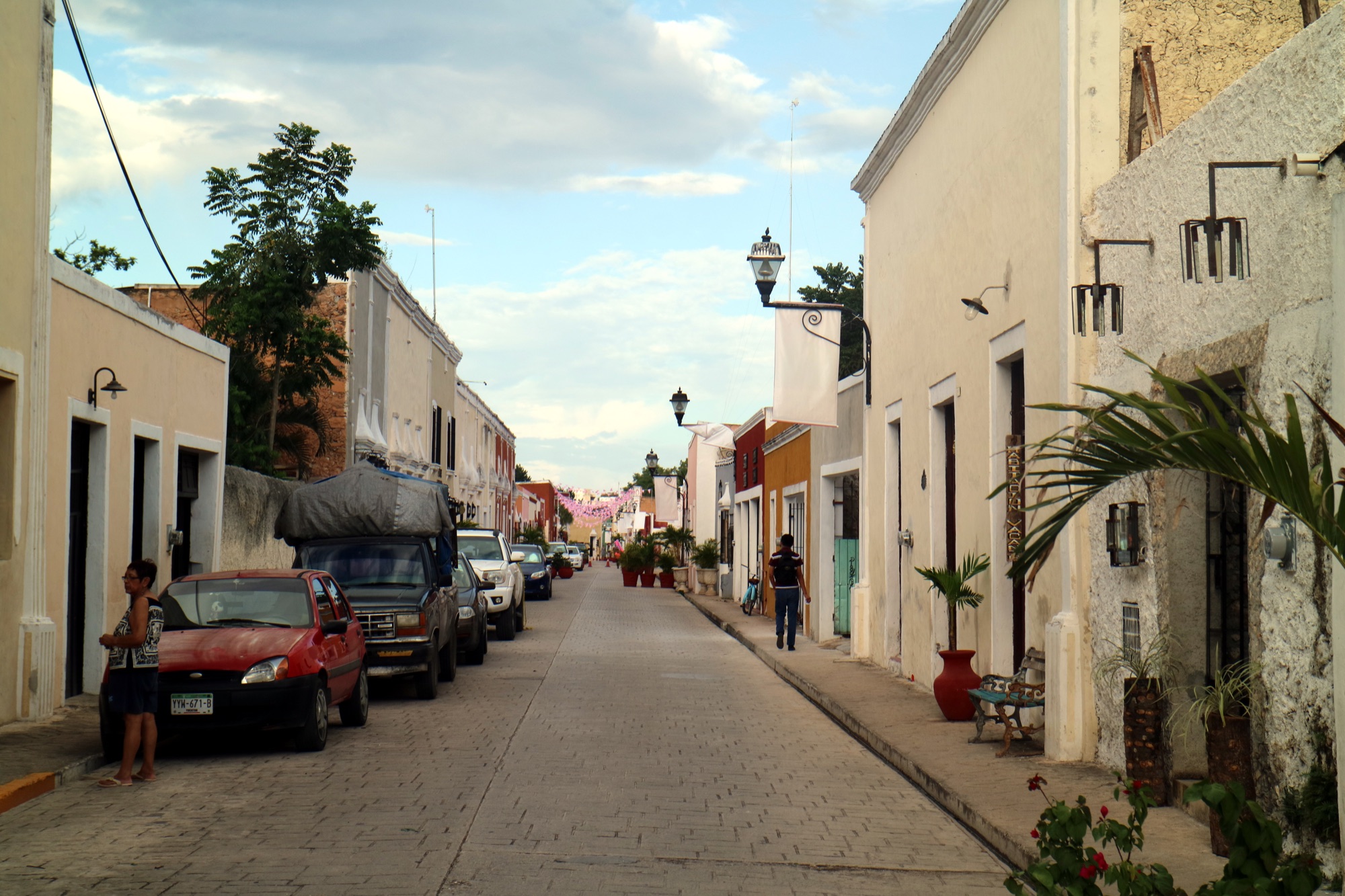
Valladolid's evening is the main square, Parque Francisco Cantón Rosado, the Calzada de los Frailes as the light goes, and the restaurants of Calle 41 and around the convent. It is pleasant and it is short, which is fine when the next morning starts at 07:00 for a ruin. If you are the kind of traveller for whom the day begins at dinner, three nights here will feel like one too many.
What the choice does to your nights
Five inland nights, Cancún arrival. Valladolid 3, Mérida 2. Ek Balam and Chichén Itzá from Valladolid on Days 2 and 3, bus to Mérida on Day 4, Uxmal on Day 5, fly home from Mérida or take a morning bus back to Cancún on Day 6. Two Mérida nights is enough for the city and one day trip; it is not enough for a buffer.
Six inland nights. Valladolid 3, Mérida 3. The same, with a Mérida buffer day for the museum, Progreso or the Homún cenotes. This is the inland half of the 10-day itinerary, which then adds three nights on the coast.
One base only, four nights. Valladolid if you land in Cancún: Ek Balam, Chichén Itzá, a cenote day, and a day trip to Izamal by taxi. Mérida if you land in Mérida: the city, Uxmal, Celestún or Progreso, and Chichén Itzá as a long day with a 06:30 start, or skipped in favour of Izamal and the Homún cenotes.
Mérida arrival, ten days. Mérida 3, Valladolid 3, coast 3, home from Cancún. The order reverses and the logic holds.
Cost, size and comfort
Valladolid is the cheaper town for rooms and meals and the easier one to walk, with most of what you need within ten blocks of the square. Mérida costs more at the top end, offers far more choice at every level, and needs taxis or the city buses for anything beyond the centre, including the Teya train station and the museum. Both are considered safe for visitors by the standards of the region; the Canadian government's Mexico advice, updated on 11 September 2026, places neither state under a regional advisory. Neither town is a beach base, and both are an hour behind the coast on the clock.
A note on the season
In January both towns share the same dry, cool-night weather (Mérida averages 38 mm of rain on about four days), so the season does not favour one over the other; what it does is shorten the day, which pushes the ruins to 08:00 and the evenings indoors. The Yucatán in January guide has the numbers by region and the case for putting the coast last.
Frequently asked questions
Is Valladolid or Mérida better for Chichén Itzá?
Can I visit Uxmal from Valladolid?
Which is closer to Cancún airport?
Which town has better evenings?
Is one base enough for a week?
Does the choice change if I fly into Mérida?
Photo credits
Hero: Calle 60 in central Mérida. Photo: ProtoplasmaKid, CC BY-SA 4.0, via Wikimedia Commons (resized for web display). Inline: Calzada de los Frailes, Valladolid. Photo: Erik Cleves Kristensen, CC BY 2.0, via Wikimedia Commons (resized for web display).