


On this route
The rule for Vietnam is simple once you see the timetable: fly the long legs, take the train when the journey itself is the point or the leg is under three hours, and use buses where trains do not go, which means the Mekong Delta and the last few kilometres. On a north-to-south trip the three long legs are Hanoi to the central coast (791 km by rail), the central coast to Ho Chi Minh City (935 km) and the city to Phu Quoc (an island). Two of those are 15 to 21 hours by train and about 80 minutes by air; the third has no train at all.
This guide gives the actual December 2026 timetable pattern for each leg, the fares the operators listed when we checked in September 2026, what the choice does to your nights, and how to book. It is written for the route in the 14-day December itinerary, but the legs are the same for any north-to-south trip.
The three long legs, compared
| Leg | Flight | Train (Vietnam Railways, December 2026 timetable) | Bus | Our call |
|---|---|---|---|---|
| Hanoi to Da Nang (for Hoi An) | About 1 h 20; Vietnam Airlines lists about 20 flights a day, Vietjet 13 | Six trains, 15 h 08 to 16 h 48; SE3 19:20 to 10:28 next day; soft sleeper 1.34 to 1.44 million VND | Sleeper buses exist but take about as long as the train with less comfort | Fly, unless the sleeper is part of the trip |
| Da Nang to Ho Chi Minh City | About 1 h 20; Vietjet lists 10 a day between the cities, Vietnam Airlines also flies it | Six trains, 17 h 01 to 21 h 23; SE1 13:29 to 06:30 next day | Longer than the train | Fly |
| Ho Chi Minh City to Phu Quoc | About 1 h; Vietnam Airlines lists 4 to 7 a day, Vietjet 4 | None | Bus to Rach Gia or Ha Tien plus a Superdong ferry: 6 to 8 hours door to door | Fly, unless you come from the Mekong |
| Hanoi to Ho Chi Minh City (direct) | About 2 h 10; near-hourly on Vietnam Airlines, 13 a day on Vietjet | Five trains, 32 h 45 to 38 h 26; SE1 21:45 to 06:30 two days later | Not sensible | Fly |
Flights: who flies, how often, and the last mile
Vietnam Airlines and Vietjet are the two large domestic carriers, and between them they cover every leg on a north-to-south route many times a day. Their own route pages give the frequencies quoted in the table; both were advertising December 2026 departures on these legs when checked. The two carriers price checked bags differently, so compare the total with a bag, not the headline fare.
The last mile matters more than the flight time. Noi Bai is about 30 km from Hanoi's Old Quarter, 45 to 60 minutes by taxi or Grab. Da Nang's airport is only 3 km from the city, but Hoi An is another 30 km, so allow 45 to 60 minutes and a car. Tan Son Nhat is about 8 km from District 1 and 30 to 45 minutes in traffic. Phu Quoc's airport is roughly 10 km from Duong Dong, 20 to 30 minutes, and the airline's estimate for a taxi is about 150,000 VND. Add two hours at the airport for domestic flights and the "80-minute flight" becomes a five-hour move from hotel to hotel, which is still a third of the train.
Phu Quoc also has international flights: Vietjet lists routes to Bangkok, Singapore, Seoul and Taipei, which is what makes an open-jaw ticket (into Hanoi, out of Phu Quoc) realistic without backtracking to the city.
Trains: the SE line for a December date
Vietnam Railways runs one main line, the Reunification line, from Hanoi to Ho Chi Minh City (Sai Gon station), with the SE-numbered express trains as the backbone. The official booking site is dsvn.vn, and its timetable and fare tool lets you read a specific date. For 8 December 2026 it listed these departures from Hanoi to Da Nang: SE7 at 06:00 arriving 22:15 the same day; SE5 at 08:00 arriving 00:21; SE9 at 13:00 arriving 05:48; SE3 at 19:20 arriving 10:28; SE19 at 19:45 arriving 11:35; SE1 at 21:45 arriving 13:14. The overnight trains reach Hue about two and a half hours before Da Nang; SE3 stops there at 07:50.
The fare table for SE3 Hanoi to Da Nang that day showed a four-berth soft sleeper at 1,342,000 VND (upper) to 1,435,000 VND (lower), a six-berth hard sleeper at 980,000 (upper) to 1,262,000 VND (lower), and a soft seat at 637,000 VND, with a note that prices change with booking time and berth position. Two people in a four-berth cabin therefore pay about 2.7 to 2.9 million VND, in the range of two flight tickets, and they save a hotel night, so the train is a fair swap on price and a loss on time: you arrive at 10:28 instead of 21:00 the evening before, which is a Hoi An morning gone.
Da Nang to Ho Chi Minh City is where the train stops being a fair swap. The 12 December listing showed SE1 at 13:29 arriving 06:30 the next day (17 hours), SE3 at 10:43 arriving 05:30, and SE7 at 22:30 arriving 17:00 the following afternoon. None of them fits a two-week trip. The train earns its place on the Hanoi to Da Nang leg, on the short Hanoi to Ninh Binh hop (about 2 hours 13 minutes on every train), and on the Hue to Da Nang section over the Hai Van pass (about two and a half hours), which is the scenic stretch people mean when they praise the Vietnamese railway.

Buses and sleeper buses
Buses win where the railway does not go. The Mekong Delta is the clear case: Ho Chi Minh City to Can Tho is about 191 km and averages 3.9 hours on the aggregator listings, with Phuong Trang (FUTA), one of the largest operators, at about 195,000 VND and departures around the clock. Can Tho to Rach Gia, the ferry port for Phu Quoc, is about 108 km and two and a half hours, with Phuong Trang listing 06:00, 08:00, 12:00, 13:30, 17:00 and 19:00 for about 185,000 VND. These figures come from the Vexere booking aggregator, because the operator's own site refused our connection; treat them as a scale and check the day's departures when you book.
Long-distance sleeper buses run the whole coast as well, with reclining pods rather than flat beds. On the legs where a train exists they are the cheaper and less comfortable option over a similar time; on a two-week trip they only make sense for a budget-first traveller who has already decided against the flight.
Ferries: Phu Quoc
Superdong's published schedule lists four sailings a day from Ha Tien (06:10, 08:20, 09:50, 13:00; about 1 hour 15 minutes; 230,000 VND for an adult) and four from Rach Gia (07:00, 07:55, 10:30, 13:10; about two and a half hours; 330,000 VND), all to Bai Vong port on the island's east coast, with a 40,000 VND shuttle to Duong Dong. Return sailings leave Phu Quoc between 06:40 and 13:30. Winter seas can cancel departures, so do not put a ferry on the day before a flight you cannot miss. From Ho Chi Minh City the ferry route is a four-hour bus plus the crossing; it is the right choice only when you are already in the delta. The Phu Quoc or Mekong Delta comparison shows the full chain with connection times.
Short hops and the last mile
Hanoi to Ninh Binh. Train, about 2 hours 13 minutes, six departures a day on the December timetable from 06:00 to 21:45. Hire a car for the return if you want to leave after dark.
Hanoi to Ha Long Bay. Cruise operators include a shuttle from the Old Quarter, about two and a half to three hours, and most will drop you at Noi Bai airport on the return if you ask when booking. There is no useful passenger train for this leg.
Da Nang to Hoi An. About 30 km, 45 to 60 minutes by taxi, Grab or a hotel car. Agree the price or use the app; there is no train.
In cities. The UK Foreign Office's advice is the practical one: metered taxis from the larger firms are reliable, the Grab app lets you check the car and driver before you get in, and motorbike riding is much riskier than at home, with a helmet and a reputable rental as the minimum if you do it. For a first trip, use Grab and taxis and leave the scooter for Phu Quoc's quiet roads if at all.
Decision rules
Over 600 km: fly. That is Hanoi to Da Nang, Da Nang to Ho Chi Minh City and anything longer. The exception is a deliberate overnight on SE3 from Hanoi, chosen for the journey.
Under 150 km: train where it exists (Hanoi to Ninh Binh, Hue to Da Nang), otherwise a car or bus. The train is cheaper and more predictable than road traffic.
No railway: bus or operator shuttle. The Mekong, Ha Long Bay and the ferry ports are all bus territory; the shuttles that cruise companies and Phu Quoc ferries run are part of the product.
Nights are the currency. An overnight train replaces a hotel night and costs a morning; a morning flight costs nothing but the airport time. On a 14-day trip that trade is worth making once, on the first long leg, and not twice. The winter-by-region guide explains why the second leg is better spent arriving early in the dry south.
Booking calendar for December to February
Flights: six to ten weeks ahead for December, earlier for the two weeks before Tet on 6 February 2027, when domestic seats and prices move fast. Trains: dsvn.vn sells in advance; buy the SE3 berth as soon as dates are fixed, since the four-berth lower bunks go first. Ha Long cruises: with the flights, because the disembarkation time fixes your Day 5 flight. Buses and ferries: a day or two ahead is enough outside Tet; Superdong and the big bus companies sell online. Day tours and Mekong trips: on arrival.
Frequently asked questions
Is the train from Hanoi to Da Nang worth it?
How long is the train from Da Nang to Ho Chi Minh City?
Is there a train to Phu Quoc or Ha Long Bay?
Which airlines fly domestic routes in Vietnam?
How do I book Vietnamese trains from abroad?
Are sleeper buses a good option?
Photo credits
- Da Nang railway station (cover and inline). Photo: calflier001, CC BY-SA 2.0, via Wikimedia Commons (resized for web display).
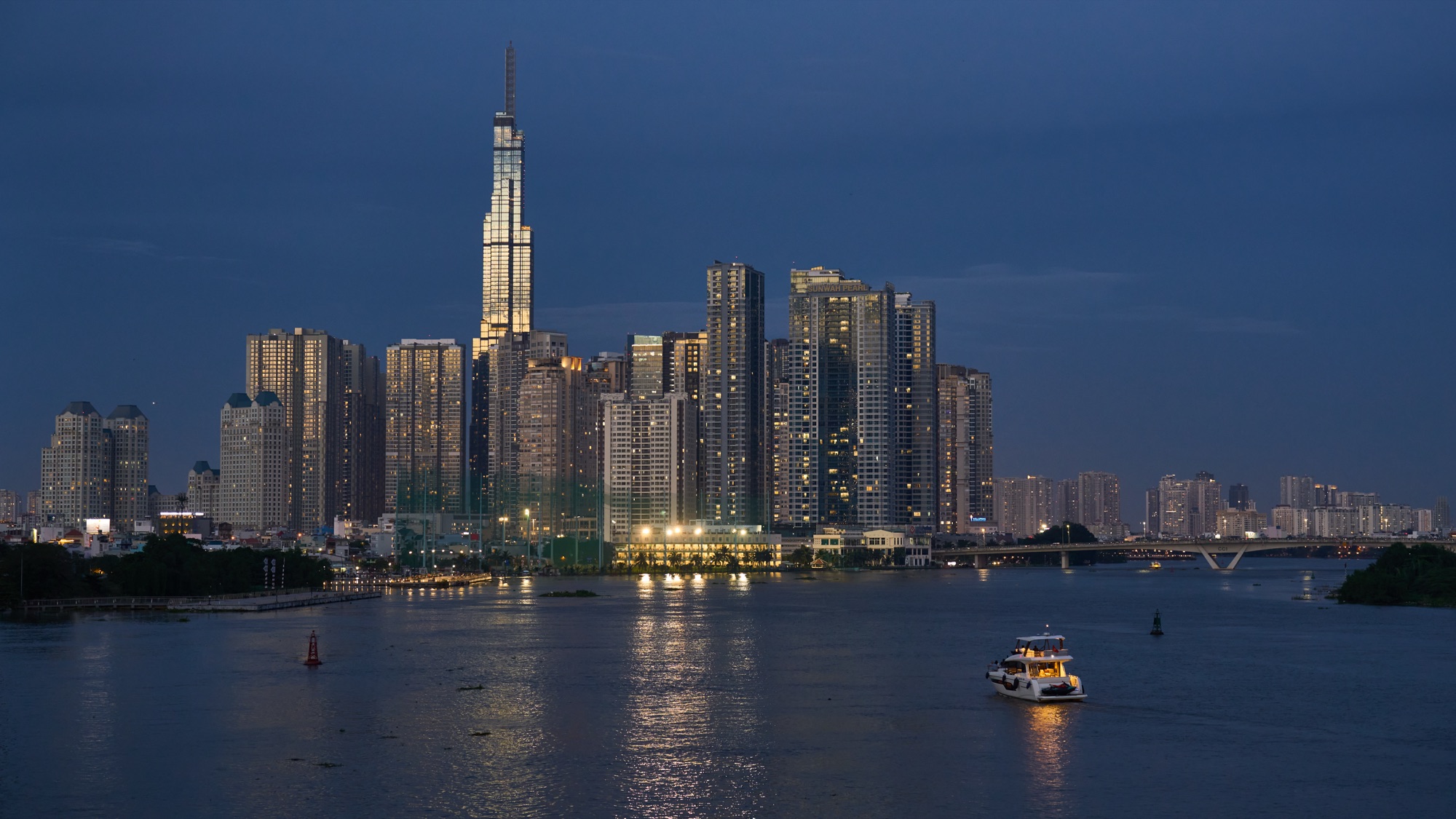
- Ho Chi Minh City at dusk. Photo: Radek Kucharski, CC BY 2.0, via Wikimedia Commons (resized for web display).
Sources checked 17 September 2026: Vietnam Railways timetable and fare tool (dsvn.vn) for 4, 8 and 12 December 2026; Vietnam Airlines and Vietjet route pages; Superdong ferry schedule and fares; Vexere listings for Phuong Trang buses; UK Foreign Office Vietnam travel advice (road safety).