


On this route
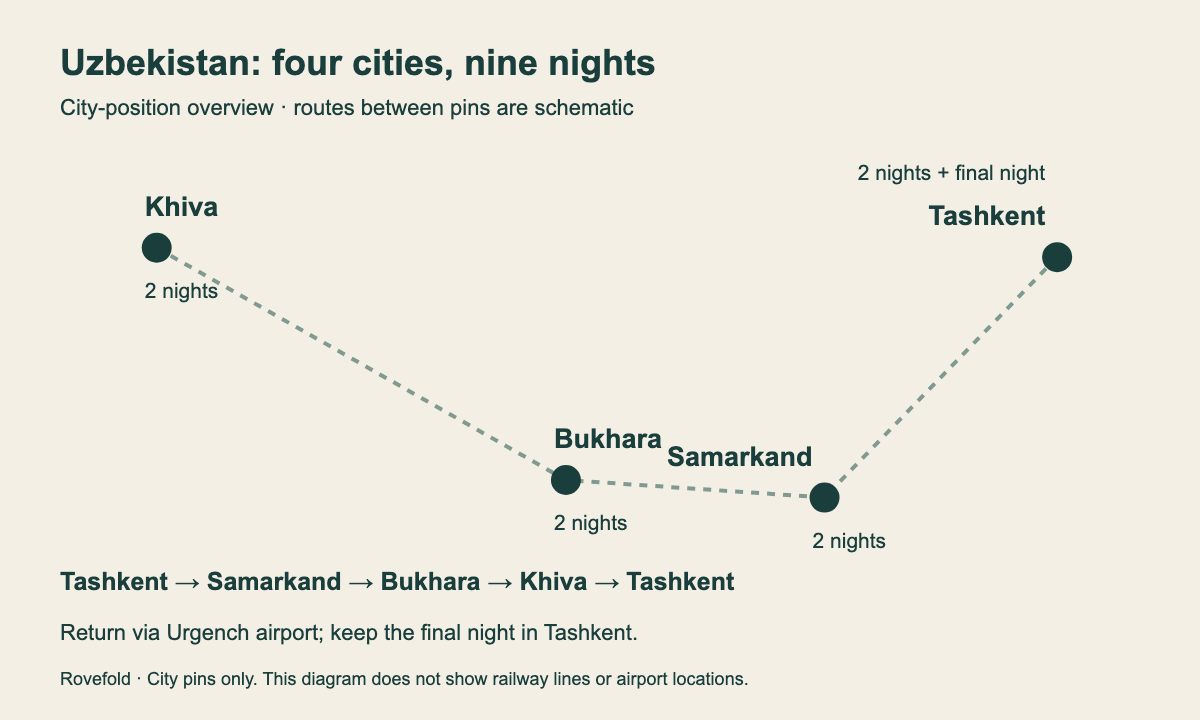
Yes, ten days is enough for Tashkent, Samarkand, Bukhara and Khiva, but only if the route keeps moving west and treats one day as a genuine transfer. The realistic sequence is Tashkent → Samarkand → Bukhara → Khiva → Tashkent, using reserved trains for the central corridor and a short domestic flight from Urgench for the return.
This plan gives each historic city two nights, keeps the Bukhara–Khiva transfer day deliberately light and finishes with a buffer night in Tashkent before departure. It is active, but it does not rely on overnight transport or pretend that four cities can be explored in four half-days.
- Duration
- 10 days / 9 nights
- Bases
- 4 cities / 5 stays
- Transport
- Reserved trains, overland transfer and domestic flight
- Pace
- Active but realistic
- Best season
- April–May and September–October
Route at a glance
| Day | Main plan | Overnight | Transport reality |
|---|---|---|---|
| 1 | Arrive in Tashkent and take an easy central orientation walk | Tashkent | Keep the plan flexible around the flight |
| 2 | Chorsu Bazaar, Hast Imam and selected metro stations | Tashkent | Metro, walking and a short taxi |
| 3 | Train to Samarkand; Registan after check-in | Samarkand | Reserve a morning train |
| 4 | Shah-i-Zinda, Bibi-Khanym, Siab Bazaar and Gur-e-Amir | Samarkand | Mostly walking with one short taxi |
| 5 | Train to Bukhara; Lyabi-Hauz and the old town | Bukhara | Use a morning or midday train |
| 6 | Po-i-Kalyan, the Ark, Bolo Haouz and Samanid Mausoleum | Bukhara | Walking plus a short taxi for the outer stop |
| 7 | Travel from Bukhara to Khiva; sunset walk if time remains | Khiva | Book the actual train first; keep sightseeing optional |
| 8 | Itchan Kala, Kunya-Ark, Kalta Minor and Juma Mosque | Khiva | Walk inside the walled city |
| 9 | Khiva morning; fly from Urgench to Tashkent | Tashkent | Do not connect directly to an international flight |
| 10 | Depart Tashkent | Not applicable | Keep the morning near your luggage |
Choose the overnight bases
Base sequence
- Tashkent 2 nights
- Samarkand 2 nights
- Bukhara 2 nights
- Khiva 2 nights
- Tashkent 1 night
Before changing the two-night balance, compare whether to spend more time in Samarkand or Bukhara, while preserving the route's transfer and departure buffers.
The second Tashkent stay is intentional. It gives you an easy arrival, then a protected final night after the domestic flight. Removing that last buffer may save one hotel night, but it turns an ordinary delay into a risk to the international departure.
Days 1–2: Start in Tashkent
Keep Day 1 small. After check-in, choose one compact area: Amir Temur Square and the central avenues, a short park walk, or dinner near your hotel. Arrival time, immigration and traffic matter more than any fixed sightseeing list.
Use Day 2 to understand the capital rather than treating it as an airport. Begin at Chorsu Bazaar, continue to Hast Imam Square and use the metro between neighborhoods. The stations are part of the experience, but the network is still your transport, so choose a few useful stops instead of riding all day for photographs.
Book accommodation with straightforward access to a metro station or reliable taxi pickup. Tashkent is far larger than the later historic centers, so a cheap room on the wrong side of the city can create more friction than it saves.
Best rhythm: old city in the morning, a long lunch, then central Tashkent and selected metro stations later in the day.
Days 3–4: Give Samarkand two nights
Take a morning train from Tashkent and treat the station-to-hotel journey as part of Day 3. After check-in, orient yourself around Registan. The square changes character as the light moves, so there is no need to force every major monument into the first afternoon.
On Day 4, start early at Shah-i-Zinda before the narrow passage becomes busy. Continue toward Bibi-Khanym Mosque and Siab Bazaar, then leave Gur-e-Amir for later in the day. These places are close enough to combine, but each rewards time to look rather than a ten-minute photo stop.
Ulugh Beg Observatory is worthwhile for travelers interested in science and history, but it sits outside the most efficient walking line. Add it only if you are happy to use a taxi and remove something else.
Days 5–6: Slow the route in Bukhara
Travel to Bukhara on Day 5 and check into the old-town area. The railway station is outside the historic center, so allow time for the road transfer before planning lunch or a tour. Spend the afternoon around Lyabi-Hauz, the trading domes and the lanes connecting the monuments.
Day 6 is the full architectural day. Begin around Po-i-Kalyan while the light is softer, continue to the Ark and Bolo Haouz Mosque, then use a short taxi or a longer walk for the Samanid Mausoleum. Bukhara works best as a sequence of courtyards and streets, not as a list of interiors purchased one by one.
Keep the second Bukhara evening free. Day 7 changes your base to Khiva, so a late performance or complicated excursion is a poor trade unless your transport leaves late.
Days 7–8: Make Khiva worth the journey
Start by comparing Bukhara–Khiva train options for your exact date. On 9 September 2026, the official search for 17 September showed a Jaloliddin Manguberdi service from Bukhara at 11:14 to Khiva at 14:42, taking 3 hours 28 minutes. It also showed slower early-morning and afternoon choices. This is a dated example, not a daily timetable or a promise of available seats. A faster train can leave you an afternoon in Khiva, but keep that time flexible until your ticket is confirmed.
If you arrive before sunset, take an orientation walk inside Itchan Kala and stop there. Save ticketed interiors and towers for Day 8, when you can begin early and move on foot.

On Day 8, begin with Kunya-Ark and the western gate area, then continue past Kalta Minor toward Juma Mosque and the Islam Khoja ensemble. Climbing a viewpoint can be worthwhile when open, but current access, heat and queues should decide. The walled city is compact enough to revisit your favorite streets after lunch instead of chasing every museum room.
Days 9–10: Return without risking the flight home
Use the morning for one last Khiva walk, then transfer to Urgench airport for a domestic flight to Tashkent. Uzbekistan Airways currently operates the route, but frequencies and departure times vary by date. Search the official booking site before fixing the hotel order.
Sleep in Tashkent on Day 9. Choose an airport hotel for an early departure or a metro-connected central hotel for a late flight. Day 10 should contain only activities that can be abandoned without penalty.
If the domestic flight does not work on your dates, the fallback is a train from Khiva or Urgench with a larger time allowance. Rebuild Day 9 around that journey rather than squeezing it into the same plan.
Count the whole transfer, not only the train
For each rail leg, add hotel checkout and the trip to the departure station, the operator's boarding allowance, the scheduled ride, the arrival-station transfer and check-in. Bukhara station is at Kogon, outside the old town. A two-night stay gives you one full day plus usable parts of arrival and departure, not two full sightseeing days.
For Day 9, include the road trip from Khiva to Urgench airport, airline check-in and security, the flight and the transfer to your Tashkent hotel. A published flight time is not the length of this hotel-to-hotel journey. If the only workable return train arrives on Day 10, it does not preserve this itinerary: leave Khiva earlier, add a night or omit Khiva.
Transport reality and booking order
| Segment | Default choice | Backup | What to verify |
|---|---|---|---|
| Tashkent–Samarkand | Reserved fast train | Other reserved train or flight | Station, departure time and baggage needs |
| Samarkand–Bukhara | Reserved train | Private transfer | Arrival station and hotel transfer |
| Bukhara–Khiva | Confirmed direct train | Quoted road transfer if rail does not fit | Operating day, duration and arrival point |
| Khiva–Urgench | Prebooked taxi | Hotel transfer | Airport, pickup and check-in margin |
| Urgench–Tashkent | Domestic flight | Long-distance train | Exact date, baggage and terminal |
Search trains through the official Uzbekistan Railways timetable. Reserve the fixed intercity legs after your international flights and before committing to non-refundable hotels. The sample search had limited seats on some services, which is a reason to check early, not evidence of a universal booking window.
When to go
April to May and September to October offer the best balance for this city route: useful daylight and more comfortable walking temperatures than peak summer. This is a seasonal planning recommendation, not a weather guarantee. Check the forecast and your actual train inventory before committing.
June through August is workable, but the heat changes the daily rhythm. Begin monuments early, take a long indoor or shaded break around midday and return outside later. Khiva and Bukhara are not places where an ambitious noon walking tour improves the trip.
Winter can be atmospheric and quieter, but mornings are cold, daylight is shorter and the shorter day leaves less margin for outdoor visits. Keep the route, lower the daily sight count and verify every long connection.
Budget and accommodation strategy
The route works at several budgets, but location matters more than room category. In Samarkand, stay within an easy taxi ride or walk of Registan. In Bukhara and Khiva, pay for a practical old-town position so you can explore early and after day visitors leave. In Tashkent, prioritize metro access on arrival and airport logic on the final night.
Keep separate allowances for reserved trains, the Bukhara–Khiva transfer, the domestic flight, station taxis and monument tickets. Prices change too often for a single article total to remain useful; compare the official transport results for your dates, then add accommodation and a contingency margin.
- Book international flights and the Day 9 return connection first.
- Reserve Tashkent–Samarkand and Samarkand–Bukhara trains next.
- Choose the Bukhara–Khiva mode only after seeing the current timetable.
- Reserve old-town accommodation with a flexible cancellation policy where possible.
- Carry more than one payment method and enough local cash for small purchases and backup transport.
Common mistakes and what to skip
The most common mistake is adding destinations without adding nights. Shakhrisabz can be a worthwhile trip from Samarkand, but in this schedule it consumes the only full day allocated to the city. The Fergana Valley sends the route east when every later base lies west. An Aral Sea journey is not a quick extension from Khiva; it needs a different route and more time.
Another mistake is treating Bukhara–Khiva as a sightseeing day with a transfer attached. Reverse that logic: secure the transfer, assume it uses the day and regard any sunset walk as a bonus.
Finally, do not connect the Urgench flight directly to your flight home. The final Tashkent night is the small compromise that makes the whole ten-day route dependable.
Who this itinerary suits
Choose this route if you want a first look at Uzbekistan's four best-known city experiences, are comfortable moving every two nights and prefer trains to a full-time driver. It works especially well for travelers who enjoy architecture, markets, city walking and a clear east-to-west sequence.
Add time for slow museum visits or a separate excursion. An Aral Sea extension needs its own transport and overnight plan, not an automatic two-day addition. Remove Khiva if you have only seven days; Tashkent, Samarkand and Bukhara form the cleaner short trip.
Uzbekistan itinerary FAQs
Short answers to the decisions that most often change this route.
Is 10 days enough for Uzbekistan?
Which direction should I travel?
Do I need a private driver?
Should I take an overnight train to Khiva?
Can I add Shakhrisabz?
When should I book trains?
Do I need a visa?
What if the Urgench–Tashkent flight does not work?
Final verdict
This is a realistic ten-day Uzbekistan itinerary because it makes one hard choice: four cities, no extra region. Two nights in each historic base create enough depth, the Bukhara–Khiva day remains honest and the final Tashkent night protects the flight home.
Before booking, check entry eligibility through Uzbekistan's official e-visa portal, then verify trains and the Urgench return for your exact dates. Recheck operating details once your dates are fixed.
Explore the Uzbekistan guides
Continue with the Uzbekistan travel guides and the Samarkand or Bukhara comparison.
Sources and photography
Rail example: Uzbekistan Railways, checked 9 September 2026 for 17 September. Heritage context: Samarkand, Bukhara and Itchan Kala. Seasonal context: Uzbekistan Travel.
Hero: Registan 02. Inline: Itchan Kala wall 01. Both by Bgag, CC0 1.0, resized for web display.

