


On this route
Morocco in winter is three different countries with three different answers. The cities are easy: Marrakech runs at 19 to 20 °C by day from December to February, with a handful of rain days a month and cold nights. The Atlantic coast is mild but wet and windy: Essaouira sits at 18 to 19 °C by day, 11 to 13 °C at night, with about five rain days a month and a strong wind most days. The desert is where winter bites: the nearest weather station to the Merzouga dunes records frost on about three nights in December and seven in January, and reaching the dunes costs two nights of driving days. Add two things nobody's temperature table mentions: Morocco returns to permanent GMT on 20 September 2026, so winter sunsets come around 17:30, and Ramadan 2027 is expected to run from about 8 February to about 9 or 10 March. This guide takes each of those in turn and ends with what they do to a one-week route.
Winter by region at a glance
| Region and station | December | January | What changes in winter |
|---|---|---|---|
| Cities: Marrakech | 20.1 / 7.3 °C, 24 mm | 19.1 / 5.9 °C, 25 mm | Warm afternoons, cold riad nights, early sunsets; four rain days a month |
| Atlantic coast: Essaouira | 19.4 / 12.6 °C, 56 mm | 18.4 / 11.1 °C, 49 mm | Mildest nights on this page, wettest months of its year, wind on about 12 days a month |
| Southern coast: Agadir | 22.1 / 10.1 °C, 47 mm | 21.1 / 8.4 °C, 32 mm | Warmest winter days on the coast; still not swimming weather for most people |
| Desert gateway: Ouarzazate | 17.7 / 3.2 °C, 10 mm | 17.3 / 1.8 °C, 6 mm | Dry and sunny by day, frost on 3 to 8 nights a month |
| Near the dunes: Errachidia | 16.7 / 3.5 °C, 8 mm | 15.9 / 2.0 °C, 10 mm | Camp nights near freezing; the dunes themselves have no official normal |
Two cautions on reading this. Normals are averages over thirty years, so any given week can be five degrees either side, and a rain day on the coast often means a morning shower and a clear afternoon. And the desert row uses the nearest standard stations, more than 100 km from the dunes; the camps at Erg Chebbi are lower and can be a little warmer by day, but the nights are what you will remember.
Month by month
October and November: the best of the year
If you can choose, choose these. Marrakech normals are 28.5 °C by day in October and 23.1 °C in November, Essaouira 22.2 and 20.5 °C, and the desert is warm enough (26.8 °C by day at Errachidia in October, 20.6 in November) that a camp night is cold rather than freezing. Sunsets are around 18:00 in mid-October and 17:30 by mid-November. October is also the driest of the six months for Marrakech at 19 mm. The only argument against is price and crowds in Marrakech during the European autumn holidays.
December and January: cities and coast, yes; desert with care
Marrakech at 19 to 20 °C by day is comfortable walking weather, and the low sun makes the medina kinder to photograph than in summer. The cost is the nights: 6 to 7 °C on the normals, and many riads have no central heating, so ask about heating before you book. Essaouira is milder at night than anywhere else on this page, but December and January are its wettest months at 49 to 56 mm, and the wind is a constant rather than a risk. The desert is at its coldest; more on that below. The Christmas and New Year fortnight is typically the one time Marrakech is busy and expensive in winter, so book early or avoid those two weeks.
February and March: warming up, with Ramadan in the middle
Marrakech climbs to 20.7 °C by day in February and 23.6 °C in March, the desert nights ease (frost on about one night in February at Errachidia, none in March), and daylight stretches to 11 hours by mid-February. The complication is Ramadan, expected to begin around 8 February 2027 and run 29 or 30 days to Eid al-Fitr on about 9 or 10 March, subject to the moon sighting announced in Morocco. What that means for a traveller is covered in its own section below.
The clock change nobody mentions
Since 2018 Morocco had kept its clocks on GMT+1, stepping back to GMT only for Ramadan. In June 2026 the government announced a return to GMT (UTC+0) as legal time from 20 September 2026. For a winter visitor this simply means the sun sets an hour earlier on the clock than in recent guidebooks: about 17:30 in Marrakech in mid-December, 17:50 in mid-January, and 17:15 at Merzouga in mid-December. Sunrise is after 07:20 through December and January. Ten hours of daylight is plenty for two sights and a long lunch; it is not plenty for a day trip with three hours of driving each way.
Cities in winter
Marrakech is the obvious winter city and the one with the flights: easyJet opened a three-aircraft base there in April 2026, and Ryanair's winter 2026 schedule for Morocco lists 156 routes across 13 airports. The practical winter list is short. Book a riad with heating or at least electric radiators and thick blankets. Walk the medina in the morning and after 15:00, when the low sun reaches the lanes. Jardin Majorelle needs an online timed ticket bought in advance from the garden's own site. Rain, when it comes, tends to arrive in a day or two of showers rather than a wet week: the normals give Marrakech four rain days in December and three in January.
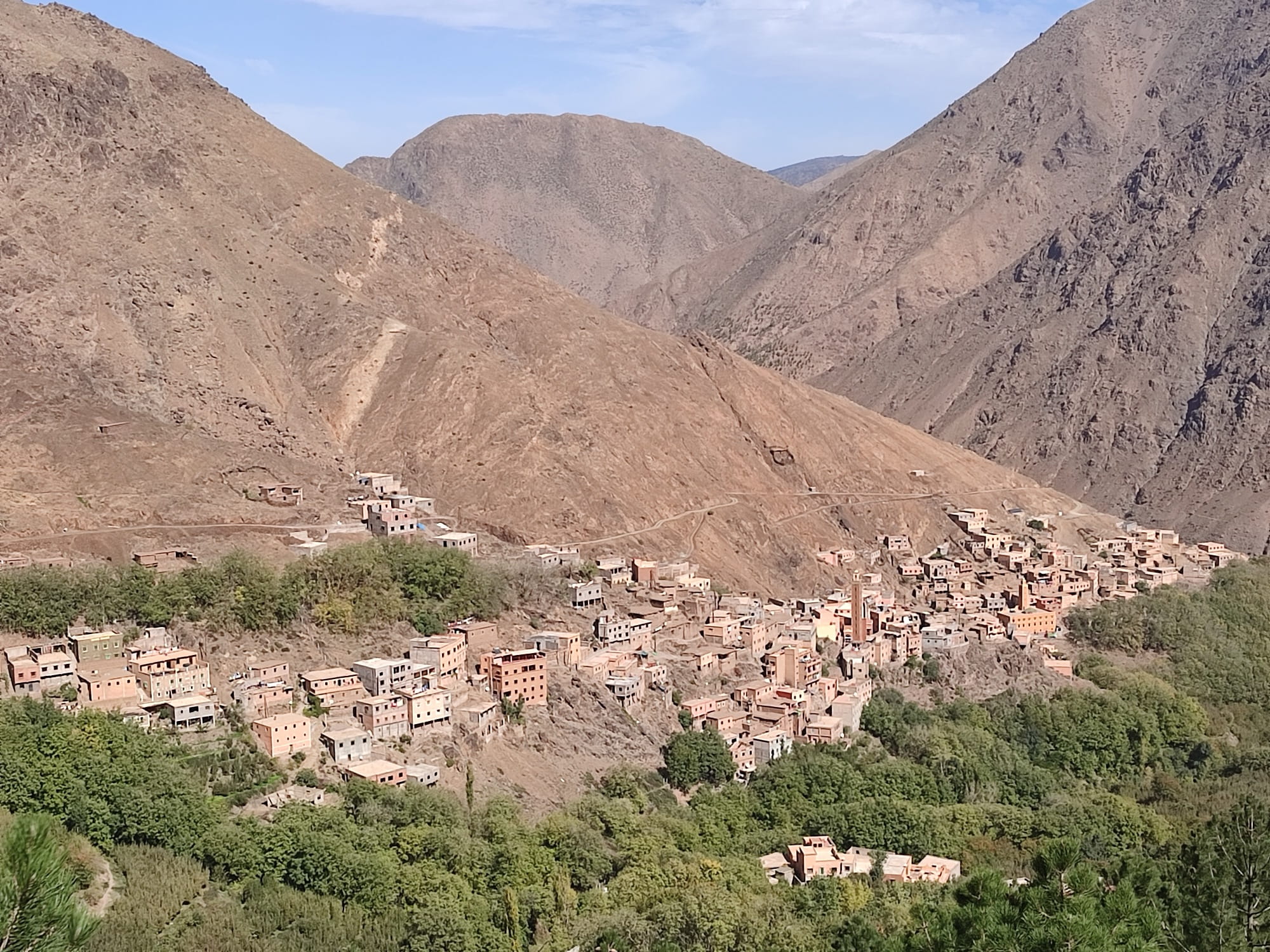
The Atlas is the winter city's bonus. Snow on the peaks is visible from Marrakech rooftops on clear days, and Imlil, about 65 km away, gives you a mountain village and a walk in cold, bright air within a long day trip. Allow 1.5 to 2 hours each way by grand taxi or driver and ask about the road if it has snowed. Fes, the other great winter city, is about 530 km from Marrakech, a full travel day, and is not part of the one-week route this guide serves.
The coast in winter
Essaouira is the coastal base that fits a Marrakech week: 183 km and a three-hour bus. In winter it is a walking and eating town, not a beach town. Daytime normals of 18 to 19 °C, nights of 11 to 13 °C, about five rain days a month, and a wind that the station records at 10 metres per second or more on about twelve days a month from October to January (17 days in March). The medina, listed by UNESCO in 2001 as a late-18th-century fortified port, is compact enough that rain costs you an hour, not a day. If you want warmer afternoons on the sea, Agadir is the answer at 21 to 22 °C by day, but it is a resort strip rather than a medina and it is about 250 km from Marrakech by road, which changes the whole route.
The desert in winter

The dunes are at their most beautiful in winter light and their least comfortable after dark. Errachidia and Ouarzazate, the nearest standard stations, both sit around 16 to 18 °C by day in December and January with nights around 2 to 3.5 °C on the normals and frost on three to eight nights a month. A camp with a wood stove in the dining tent and proper blankets is fine; a cheap camp is not. The bigger winter cost is time. From Marrakech, Erg Chebbi is about 550 km and ten hours of driving each way; the standard shared tour spends seven hours on the road on day one, five on day two and ten on day three, returning to Marrakech at 18:00 to 19:00. That is two nights away and one day that is entirely road, with sunsets before 17:30. Zagora is closer (about 350 km, seven hours each way) for one night among small dunes. Either way, the desert in a one-week winter trip is a choice against something else, which is the subject of the Essaouira or the Sahara comparison.
Ramadan 2027: what actually changes
By astronomical calculation Ramadan 2027 begins around 8 February and lasts 29 or 30 days, with Eid al-Fitr expected on 9 or 10 March; Morocco announces the exact dates after the moon sighting, often a day after the Gulf. It is a fine time to visit if you accept the rhythm. During daylight most Moroccans do not eat, drink or smoke, many cafes and some restaurants close until sunset, and opening hours shorten, especially in the afternoon. Tourist restaurants in Marrakech and Essaouira mostly stay open, and visitors are not expected to fast, but eating and drinking discreetly in the street is basic courtesy. After sunset the cities come alive: the streets fill, families eat out late, and the squares stay busy well into the night. Alcohol is harder to find. Around Eid many Moroccans travel home, so expect full buses and book transport early for the days either side of 9 and 10 March. If none of that appeals, go before 8 February or after mid-March.
What this does to a one-week route
The three regions do not share a week well in winter, and the reason is arithmetic, not taste.
- Cities and coast (recommended): Marrakech 3 nights, Essaouira 3 nights, one three-hour bus. Winter changes only the packing list and the sunset times. This is the 7-day Marrakech and Essaouira itinerary, with the bus timetable verified for December dates.
- Cities and desert: Marrakech 4 nights and a three-day Merzouga tour (2 nights). You lose the coast entirely, and the tour's third day, ten hours of road, lands in the middle of your week. In January you also spend two nights near freezing.
- Cities, coast and desert in seven days: not recommended. It means Marrakech 2, desert 2, Essaouira 2 with four of seven days dominated by transfers, and in winter every one of those transfer days ends after dark.
- Ten days or more: the desert stops being a trade-off. Marrakech 3, Merzouga tour 2 nights, Marrakech 1, Essaouira 3 is a sane ten-day winter shape, though it is not validated here.
How to make the one transfer that every winter version shares is in the Marrakech to Essaouira transport guide.
A short winter packing list
- A warm layer for riad nights and desert camps: fleece or down, plus a hat if you are sleeping in the dunes.
- A windproof shell for Essaouira; an umbrella is useless there.
- Shoes you can walk cobbles and wet lanes in; the medinas are not paved evenly.
- Sunscreen and sunglasses: the winter sun is low but strong, especially in the desert.
- Dirhams in cash for taxis, tickets and the souks; one euro bought about 10.9 dirhams at the time of writing.
Questions about Morocco in winter
Is Morocco warm in December and January?
Is it worth going to the Sahara in winter?
What time does it get dark in Morocco in winter?
When is Ramadan in 2027 and should I avoid it?
Which is the best winter month for Morocco?
Does it rain much in Morocco in winter?
How this guide was checked
Temperature and rainfall figures are the WMO 1991–2020 climatological standard normals published by NOAA from Moroccan meteorological service data, for the stations named. The time-zone change is as announced by the Moroccan government in June 2026 and reported by Moroccan press. Sunset times are calculated for the stated dates on GMT. Ramadan dates are astronomical projections and will be confirmed by moon sighting. Tour shapes and driving hours are operator listings and routing-engine estimates read on 17 September 2026. Nothing here is a first-hand account.
Photo credits
- Cover: Marrakech Koutoubia Mosque, Jorge Franganillo, CC BY 2.0, via Wikimedia Commons, resized.
- Atlas mountains, Imlil, Kaur Virunurm, CC BY-SA 4.0, via Wikimedia Commons, resized.
- Erg Chebbi in the evening light, Thomas Fuhrmann, CC BY-SA 4.0, via Wikimedia Commons, resized.