


On this route
December in Madeira is two climates stacked on top of each other. At sea level in Funchal the month averages a high of 21 degrees and a low of 15.5, with about 95 mm of rain spread over nine days, and the sea is still around 20 degrees. At 1,800 metres, where the famous ridge walk runs, the Pico do Arieiro station averaged 5.4 degrees last December, dropped to minus 1, and the mountain station nearby recorded a gust of 147 km/h and 372 mm of rain in the month. Nothing about the coast tells you what the peaks are doing, and nothing about the peaks should stop you booking the coast.
The short answer for planning: base yourself on the south coast, keep the mountain and levada days movable, book trail slots the evening before because they are not refunded for weather, and give the airport a day of slack at each end. December's extras are the festive programme from 1 December to 10 January, ten hours of daylight, and the one day (25 December) when the cable car, the airport bus and the interurban buses all stop. The 7-day winter itinerary turns these rules into a week; this guide gives you the numbers behind them, region by region, so you can adapt any plan.
December by station, in numbers
The Portuguese weather service, IPMA, publishes 1991 to 2020 climate normals for Funchal (station 522, 58 metres above the sea). For the mountains and the north there is no equivalent normal online, so the table uses IPMA observations released by the regional statistics office: the 2024 annual totals and the December 2025 monthly report. They are recorded values, not thirty-year averages, and they are labelled as such.
| Month | Rain | Days with 1 mm or more | Days with 10 mm or more | Average high / low |
|---|---|---|---|---|
| October | 91 mm | 7.0 | 3.0 | 25.2 / 19.2 C |
| November | 80 mm | 7.3 | 2.3 | 22.8 / 17.0 C |
| December | 95 mm | 8.6 | 3.5 | 21.0 / 15.5 C |
| January | 67 mm | 6.2 | 2.3 | 20.0 / 14.3 C |
| February | 72 mm | 5.5 | 2.1 | 19.9 / 13.9 C |
| Station | What was recorded | Period |
|---|---|---|
| Funchal / Lido (south coast) | 296 mm of rain in the whole year | 2024 |
| Caniçal / Ponta de São Lourenço (east) | 386 mm in the year, the second driest station | 2024 |
| Santana (north coast) | 129 days with 1 mm or more, the most of any station | 2024 |
| Pico do Areeiro (1,800 m) | 1,574 mm in the year; December mean 5.4 C, minimum minus 1.0 C | 2024; December 2025 |
| Chão do Areeiro (central mountains) | 1,874 mm in the year; 372 mm in December with 20 rain days and a 147 km/h gust; normal 155 rain days a year against 61 in Funchal | 2024; December 2025 |
| Funchal / Observatório | 153 hours of sunshine in December (normal 134); sea 20.2 C at the harbour | December 2025 |
Two things follow. First, a December week in Funchal is closer to a mild autumn in southern Europe than to a winter: nine wet days in the month, three or four of them with 10 mm or more, and highs above 20. Second, the mountains multiply every number by five or six, and they do it on the same day the coast is dry. A forecast that says rain for Madeira is usually a forecast for the north and the peaks.
What the numbers do to a week, region by region
The south coast (Funchal to Calheta). The driest, warmest and most sheltered strip. This is where you sleep and where you go when the interior is wet. Museums, wine lodges and the Monte cable car keep normal hours in December, the coast road between Câmara de Lobos and Calheta is a day out in its own right, and Cabo Girão's skywalk is open 08:00 to 20:00 (5 euros over the age of 12, paid on the SIMplifica portal).
The east (Machico and the Ponta de São Lourenço peninsula). Nearly a desert by island standards, with 386 mm in 2024, and the walk to the tip (PR8, 4 km each way, about 2.5 hours, 4.50 euros) is the one classified trail that rain rarely spoils. Wind is its enemy: on a day with a wind warning for the east coast, do it after lunch or swap it.
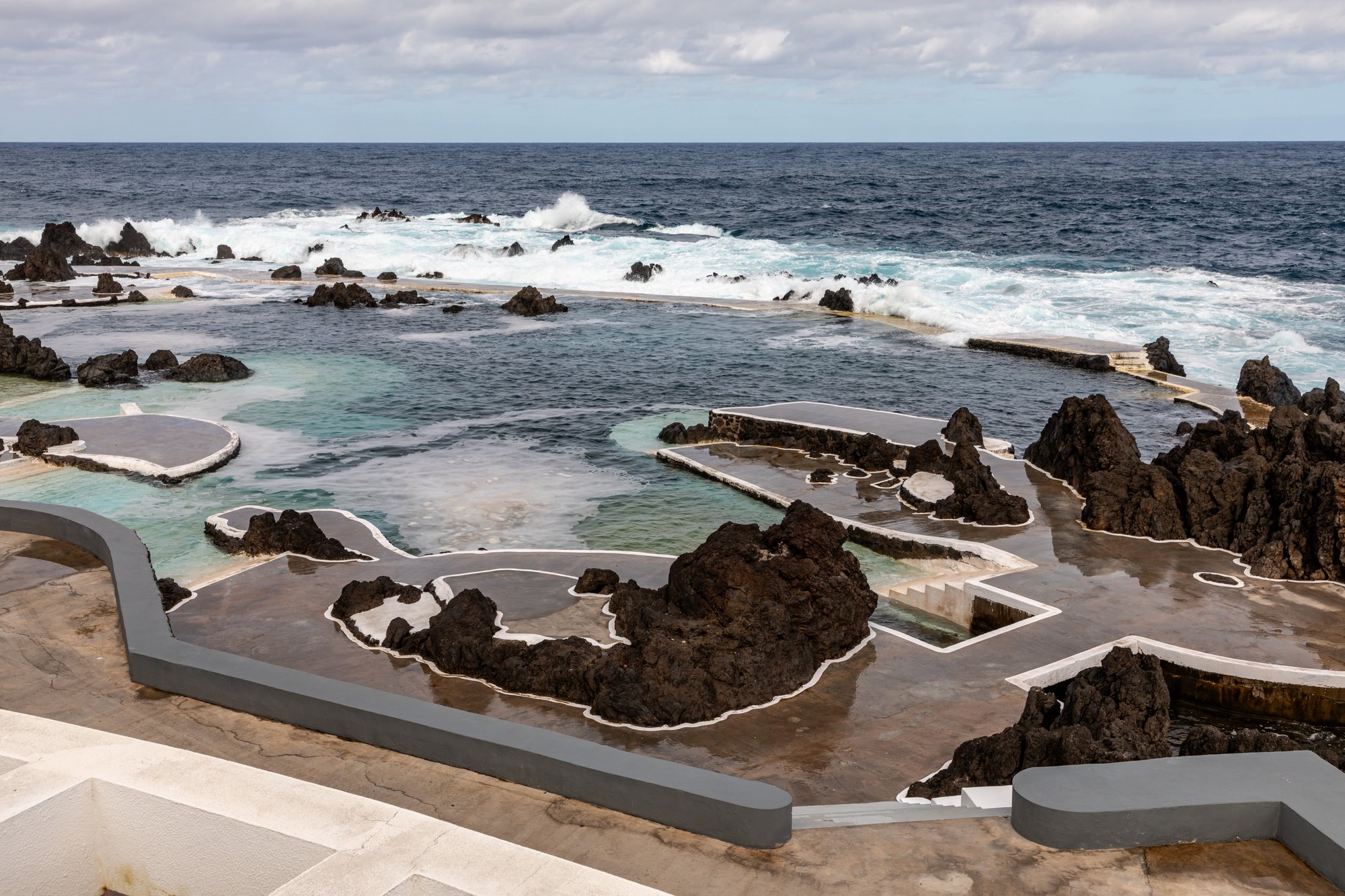
The north coast (Santana, São Vicente, Porto Moniz). The wettest lowland, and the most changeable. Santana had 129 rain days in 2024. The Porto Moniz natural pools close whenever the swell is high, which in December is frequent, so plan the pools as a bonus on a north-coast drive rather than a destination. The short Balcões walk at Ribeiro Frio (1.5 km each way, 1.5 hours) is the north's most reliable trail in poor weather because it is short, low and mostly sheltered.
The plateau and the peaks (Paul da Serra, Rabaçal, Pico do Arieiro, Pico Ruivo). The part of the island December can take away. Fog on the Paul da Serra plateau is normal, the Levada das 25 Fontes (PR6) runs at 960 to 1,290 metres, and PR1 between 1,490 and 1,860 metres. Both are worth two attempts in a week: one planned and one on a buffer day. On a clear December morning the peaks are as good as they get, with a sea of cloud below and cold, dry air above; on a wet one they are closed cloud, wind and ice on the road. The forestry institute decides trail closures case by case, weather warnings do not close trails automatically, and its trail page shows the status of every route.
Daylight, sea and sunshine
Madeira keeps the same clock as Lisbon and London in winter. In December the sun rises around 08:00 and sets around 18:00, about ten hours of daylight, which is enough for one long walk or two short ones plus a drive, but not for the summer habit of a late start. Book the first trail slots of the day, and be off the mountain roads by about 16:30. Sunshine is not scarce: Funchal's December normal is 134 hours, and December 2025 gave 153. The sea at the Funchal harbour averaged 20.2 degrees last December, warm enough for the hardy at the Lido complexes on calm days, and the tourist board quotes about 18 degrees as the winter figure. Nobody should plan a December week around swimming.
Storm days: the airport and the roads
Madeira Airport is famously exposed to crosswinds, and in winter the Atlantic depressions add rain to the wind. On 12 December 2025, 22 flights (11 departures and 11 arrivals) had already been cancelled by 07:45 as IPMA warned of gusts up to 130 km/h on the north coast and put the sea on red alert; on 13 December, during storm Emília, 126 of the 130 scheduled flights were cancelled and gusts reached 106 km/h. Diversions go to Porto Santo or the mainland, and a diverted flight can mean a night in Lisbon or Porto Santo before a second attempt. Wind is not only a winter problem (July 2025 saw more than 100 cancellations in a week), but December adds the swell and rain that close roads and trails on the same day.
The planning consequences are simple. Do not fly in on the day before something you cannot miss, and do not fly out on the day before one either. Keep travel insurance that covers a missed connection. If a storm is forecast for your arrival day, expect the hotel to hold the room but the car rental desk to close early, and have the airline app ready to rebook. On the island, the expressway stays open in almost any weather; the plateau roads across Paul da Serra to Rabaçal and the Pico do Arieiro road are the ones that fog and ice affect first.
The trails in December
Since 1 January 2026 every classified trail managed by the forestry institute needs a dated online booking on the SIMplifica portal, even for residents and children who pay nothing. Visitors pay 4.50 euros per trail, 10.50 euros for the full one-way PR1 from Pico do Arieiro to Pico Ruivo (which includes the descent trails), and 9.00 euros for two or more trails on one day excluding PR1. There is no refund or rescheduling for rain, illness or a cancelled flight; only an official closure of the trail on your date qualifies, with ten working days to ask by email. In December that rule decides your tactics: book the evening before, when the mountain forecast is visible, and keep one buffer day free until the week has shown its hand.
Two structural facts matter beyond the weather. PR1 has been one-way from the Pedra Rija viewpoint to Pico Ruivo since its reopening on 1 May 2026, so you leave the summit by PR1.2 to Achada do Teixeira (2.8 km) or PR1.1 to Ilha and arrange your own transport back; only the Arieiro to Pedra Rija section is two-way. And the Levada das 25 Fontes now runs one way, out along the levada and back by a signed bypass. Both are explained day by day, with the fees, in the winter itinerary. Check the institute's trail status page for short closures: the one-way PR1 section was shut for six days of walkway work in September 2026, for example.
Christmas and New Year: dates and what they cost
The official Christmas and New Year programme runs from 1 December 2026 to 10 January 2027, with lights and street events in Funchal through the month, the Market Night at the Mercado dos Lavradores on 23 December, the fireworks over Funchal bay at midnight on 31 December, and the Epiphany singing on 5 January before the Three Kings on 6 January. It is the busiest fortnight of the winter and priced accordingly: at one of the big Funchal hotels, the 31 December 2025 packages ran from 350 euros per adult for the party with fireworks access to 530 to 570 euros for gala dinners and 1,200 euros for the sky bar, with prepayment required, and every one of them sold out. Expect similar levels for 2026 and book early if the fireworks are the point.
Christmas Day itself is a closed day for transport: no Aerobus, no interurban buses, no cable car, and the Blandy's wine lodge and the Whale Museum close on 25 and 26 December. Museums such as the Madeira Story Centre and the Natural History Museum close only on the 25th. If your week includes Christmas, make that the rest day or the drive-yourself day, and do not plan a bus-based excursion.
Which base, and which days move
The weather argument for Funchal as the base is the whole first table: it is on the dry side, the wet-day options are within walking distance, and every day trip is under three hours of driving. A Calheta second base keeps you on the dry side and shortens the levada day; a Santana base puts you in the wettest lowland with almost nothing indoors, which only makes sense for hikers who want two mountain attempts close at hand. Funchal or a second base weighs the three against nights and driving. Within any plan, keep the peaks and the levada on days you can move, put the east loop on the windless day, and let the south-west coast absorb the wet afternoon.
Without a car the same logic holds, with one change: the peaks and Rabaçal need a shared transfer because no scheduled bus goes there, and transfer operators run in most weather but not into a closed trail. The bus days (east loop, south-west coast, Curral das Freiras, Monte) are the ones to keep flexible. Madeira without a car has the lines and the December timetable caveats.
Packing for two climates
Pack for Funchal at 21 degrees and for the ridge at 5: a light rain shell, a warm layer and a hat for the mountain day, shoes with grip for wet levada paths, and something for the sun, which is strong at altitude even in December. A head torch is sensible on any walk that starts in the last slot of the day. For the buses, carry cash: tickets bought on board cannot be paid by card. For the trails, carry the SIMplifica ticket on your phone; there is a control gate at Pedra Rija on PR1.
If you can choose: October and November instead
The same plan is easier in autumn. October in Funchal averages 25 degrees by day and 19 at night with 91 mm of rain on seven days; November is 23 and 17 with 80 mm. Daylight is an hour or two longer, the sea is warmer, the festive-season prices have not started, and the mountains carry the same risk with less cold at the top. If December is fixed, aim for the first half of the month, before the New Year premium, and treat the week as a hiking and driving trip with a warm city to come home to each evening.
Frequently asked questions
Is December a good month to visit Madeira?
How much does it rain in Madeira in December?
Can you hike Pico do Arieiro to Pico Ruivo in December?
Does the airport really close because of wind?
What is open on 25 December?
How long are the days in December?
Photo credits
Hero: ridge near Pico do Arieiro in cloud by H. Zell, CC BY-SA 3.0. Porto Moniz natural pools by Dietmar Rabich, CC BY-SA 4.0. All via Wikimedia Commons, resized.