


On this route
January is the month North Americans most often pick for Costa Rica, and for the Pacific side of the country it deserves the reputation: Liberia's long-term normals show 1.3 mm of rain in the whole month, Quepos on the central Pacific averages 46 mm across about seven showery days, and San José sits at 9 mm. The trouble starts when a plan treats the whole country as one climate. The Caribbean coast is still coming off its wettest months in January, the northern lowlands around La Fortuna are drying out but not dry, and the Monteverde ridge is entering its windiest weeks. Pick the coast first, then let the route follow.
The short answer: build a January trip on the Pacific side and the Central Valley, accept some wet mornings if you include the Arenal volcano, pack for wind and mist in Monteverde, and leave the Caribbean coast for a September trip. If you want the volcano, the cloud forest and a beach, the 10-day La Fortuna, Monteverde and Manuel Antonio route is the January-proof version of the classic triangle. If you only want sunshine, fly to Liberia and stay in Guanacaste. The rest of this guide shows the numbers behind those choices and what they do to nights, transfers and bookings.
January by region, in numbers
These are climate normals published through the World Meteorological Organization from Costa Rica's national weather service, the Instituto Meteorológico Nacional. They describe the long-run pattern, not a forecast for your week, and the station periods are old for some sites (San José's rainfall series runs to 1997, Liberia's and Limón's to 2003). The pattern they show is stable enough to plan around.
| Station (region) | December | January | February | January temperatures |
|---|---|---|---|---|
| Liberia (northern Pacific, Guanacaste) | 11 mm, 3 rain days | 1 mm, under 1 rain day | 2 mm | 20 to 33 C |
| Nicoya (Nicoya Peninsula) | 21 mm | 4 mm | 8 mm | 20 to 33 C |
| Puntarenas (Gulf of Nicoya) | 28 mm | 6 mm | 4 mm | 22 to 34 C |
| Quepos (central Pacific, Manuel Antonio) | 160 mm, 15 rain days | 46 mm, 7 rain days | 26 mm | 22 to 31 C |
| San José (Central Valley) | 40 mm | 9 mm | 5 mm | 15 to 23 C |
| Upala (northern lowlands, nearest to La Fortuna) | 194 mm | 115 mm | 65 mm | 21 to 29 C |
| Guápiles (Caribbean slope) | 452 mm, 22 rain days | 276 mm, 21 rain days | 239 mm | 19 to 28 C |
| Limón (Caribbean coast) | 449 mm, 21 rain days | 303 mm, 18 rain days | 228 mm | 21 to 29 C |
Two things stand out. First, the Pacific coast is not uniformly bone dry: Quepos still records seven rainy days in January, mostly short showers, while Guanacaste records almost none. Second, the Caribbean side gets more rain in January than the Pacific gets in its wettest months, and December is worse. There is no station in La Fortuna or Monteverde in this dataset; Upala is the closest published site on the northern plains and shares La Fortuna's Caribbean-influenced calendar, and the Monteverde preserve itself gives average temperatures of 14 to 22 degrees with mist supplying up to 40 percent of the water the forest captures.
The three calendars
The Pacific dry season
From Guanacaste down to the Osa, the dry season runs from roughly mid-December to April, and January is squarely inside it. Rivers and waterfalls are still full from the wet season, and the trade winds that make the northwest so dry also make it windy on exposed beaches. Heat is the constraint rather than rain: Liberia and Nicoya top 33 degrees on an average January afternoon, and Puntarenas 34. Plan beach mornings and shaded afternoons, and expect the year's busiest crowds and highest prices between Christmas and the first week of January.
The northern lowlands and the volcano
La Fortuna sits on the Caribbean side of the Arenal massif, where moist air from the east still delivers rain in December and January before the drier February and March. Upala's 115 mm in January is a quarter of its December figure and a fraction of the Caribbean coast's, so this is not monsoon weather: it is cloud on the cone, wet mornings and green everything. A volcano base still belongs in a January route, and the way to protect it is a buffer day and an early start, because the cone is clearest in the first hours after sunrise.
The Caribbean's reversed year
Limón, Puerto Viejo, Cahuita and Tortuguero follow a different calendar. November and December are their wettest months and January still averages 303 mm at Limón; their driest month is September, when the Pacific is at its worst, with a second lull in February and March. A January itinerary that sends you across the mountains to the Caribbean for three nights buys you the country's rainiest stretch for the price of two long transfers. Unless the Caribbean is the whole reason for the trip, save it for early autumn.
Daylight, heat and wind
Costa Rica sits ten degrees north of the equator, so days barely change through the winter: sunrise between about 05:45 and 06:00, sunset between 17:15 and 17:45, roughly eleven and a half hours of light in January and close to twelve by mid-March. That shapes a January day more than the calendar does. National parks open at 7:00 or 8:00 and the reserve slots in Monteverde run from 08:00 to mid-afternoon; wildlife, cool air and clear volcano views all belong to the first three hours. Mountain roads to Monteverde and around Lake Arenal should be driven in daylight, which in practice means arriving by 17:00.
Heat separates the coasts as much as rain does. Guanacaste's 33-degree afternoons with a dry wind feel very different from Manuel Antonio's 31 degrees with humidity and short showers, and the Central Valley's 23-degree days are the reason San José makes a comfortable first or last night. Monteverde, up on the Tilarán ridge, is a jacket destination in January.
Four January routes and who they suit
1. The classic triangle from San José (10 days)
Airport night, three nights in La Fortuna, two in Santa Elena for Monteverde, three in Manuel Antonio, morning shuttle back to the airport. This is the route the pillar validates leg by leg with January shuttle times: San José to La Fortuna at 08:15, the boat crossing to Monteverde from 07:30, the single 08:30 departure down to Manuel Antonio and the 08:30 shuttle back to the airport. It suits first visits that want variety and are willing to trade a couple of grey volcano mornings for the cloud forest and the park. The full day-by-day plan is here.
2. Volcano and Guanacaste beaches through Liberia (8 to 10 days)
Fly to Liberia, shuttle to La Fortuna (the Interbus route from the airport arrives around 14:00), three nights at the volcano, then either the boat to Monteverde for two nights or straight to the coast, and finish with four or five nights around Tamarindo, Flamingo or the Papagayo gulf before flying home from Liberia. The Interbus Monteverde to Guanacaste shuttle reaches the airport at 12:00 and continues to the beaches. This is the driest January in the country, with a new Air Canada Vancouver to Liberia service from 13 December 2026 and non-stop flights from sixteen US cities. It suits anyone who wants sun above all and does not mind wind on the beach.
3. Central Pacific and the south (7 to 10 days)
San José to Manuel Antonio by the 08:15 shuttle (arrival 11:15), three or four nights for the park and the beaches, then an hour and a half south to Uvita and the Marino Ballena coast for three nights, and back to the airport. Fewer transfers, greener scenery than Guanacaste, warm humid air and the occasional shower. It suits travellers who want wildlife and beach in the same place and would rather skip mountains entirely.
4. The short trip: Central Valley plus one base (5 to 7 days)
With a week or less, pick one of Monteverde or Manuel Antonio rather than both, and give the other to a future trip. The choice depends on days, arrival airport and what you want from the country, and we work it through in Monteverde or Manuel Antonio for a short trip.
What January changes operationally
- Park tickets sell out. Manuel Antonio National Park sells timed tickets only online through SINAC, is closed on Tuesdays and opens 7:00 to 3:00 the other six days. In the December to April high season, popular dates go early. Fix your park day before you fix the hotel nights around it.
- Monteverde runs on time slots. The preserve's self-guided circuits are booked per slot (08:00 to 14:30 in the booking engine when we checked), with a complimentary shuttle that leaves at the reserved time. Reserve as soon as the dates are set and arrive 15 minutes early.
- One shuttle a day on the mountain-to-coast leg. Interbus has a single shared departure from Monteverde to Manuel Antonio at 08:30 arriving around 12:00 (MonteTours runs at 08:00); the reverse Interbus run leaves at 14:00 and arrives at 19:00, after dark. Plan the loop clockwise.
- The boat needs a quorum. The La Fortuna to Monteverde taxi-boat-taxi runs at 07:30 and 14:00 and needs four passengers per departure, so book it a few days ahead and keep the 08:30 road shuttle as a fallback.
- Roads are at their best. Route 606 up to Monteverde is paved and a 4x4 is not needed from the San José or Pacific side; the gravel stretch from Tilarán is the only place where higher clearance earns its keep. If you are weighing a car against shuttles, the leg-by-leg comparison is in Costa Rica by rental car or shared shuttle.
- Christmas and New Year cost more. Local guides report hotel rates around double for 24 to 31 December, often with minimum stays, and lingering holiday crowds through the first week of January; a trip that starts after the second weekend of January gets the same weather with fewer people.
Which coast, then
- Sunshine first, beach every day: Guanacaste through Liberia, with the volcano as the only inland stop.
- Variety in ten days: the San José triangle, with buffer days around the volcano and the park ticket bought early.
- Wildlife and warm water, no mountains: Manuel Antonio and the southern Pacific from San José.
- A week or less: San José plus one base; Monteverde if you want cool forest and birds, Manuel Antonio if you want monkeys and a beach.
- The Caribbean: not in January. Come back in September, Limón's driest month at 146 mm, when the Pacific is in its own wet season.
Frequently asked questions
Is January a good month to visit Costa Rica?
Which coast is better in January, Pacific or Caribbean?
Does it rain in La Fortuna in January?
How cold is Monteverde in January?
Is Guanacaste or Manuel Antonio better for beaches in January?
How many hours of daylight are there in January?
Photo credits
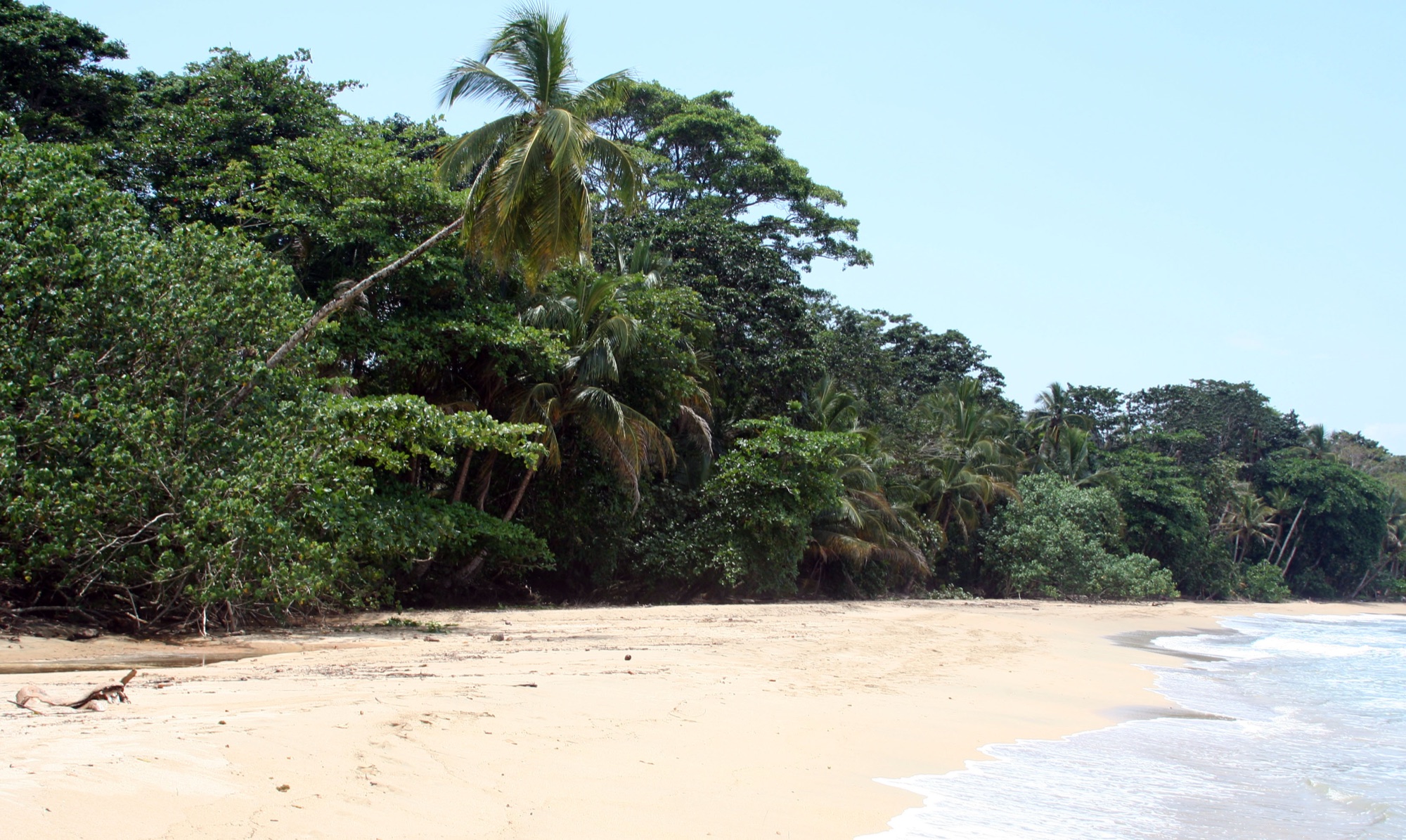
Hero: riders on Tamarindo beach at sunset, Guanacaste, by Rômulo Gama Ferreira, CC BY 2.0, via Wikimedia Commons. Puerto Viejo beach by Ben Kucinski, CC BY 2.0, via Wikimedia Commons. Both resized.